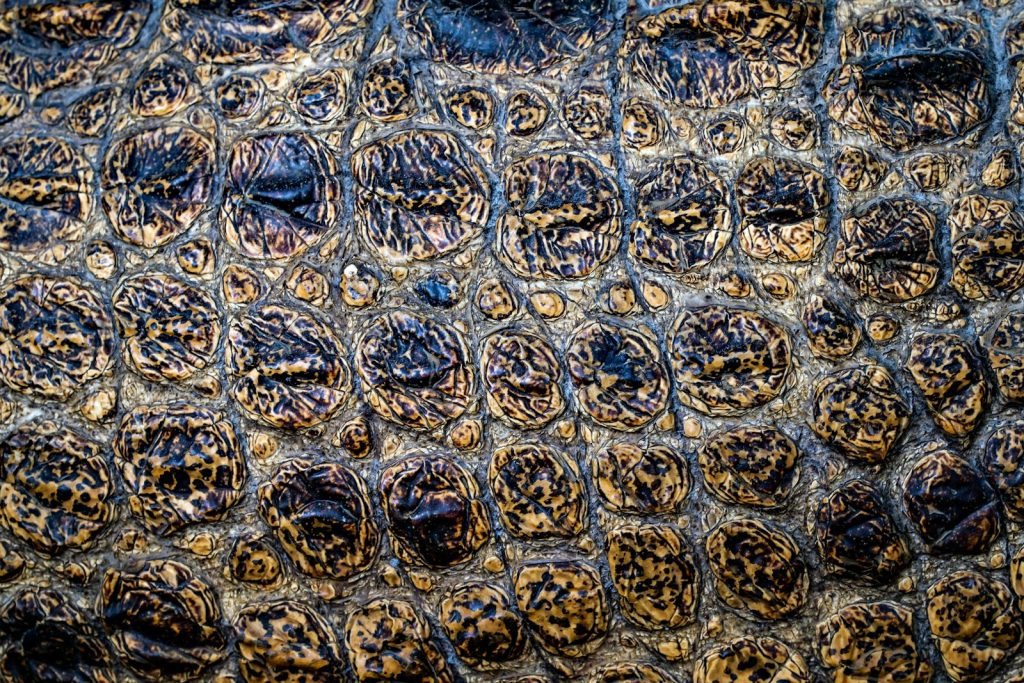
Honest sourcing note: We name every species accurately — saltwater crocodile (Crocodylus porosus), Nile crocodile (C. niloticus), American alligator (Alligator mississippiensis), caiman, reticulated python, monitor/ring lizard, ostrich and stingray — and never sell embossed calf as “exotic”. Most exotic leather is CITES-regulated (commonly Appendix II); legal cross-border trade needs export/import permits and source codes, and buyers are responsible for their country’s rules — this is general information, not legal advice; verify with your CITES Management Authority and customs broker. Prices, MOQ and lead times are indicative ranges (2025–2026), by quote. Luxury houses are referenced only as neutral examples — no affiliation. We are a B2B sourcing desk, not a tannery: we coordinate vetted, CITES-compliant suppliers.
Caiman vs crocodile leather is essentially a comparison between different reptile species, different skin structures, and very different cost profiles. Caiman is real crocodilian leather, but it is not the same species, not the same quality bracket, and not used for the same products as true crocodile.
As Lead Editor for Exotic Skins & Grading at Exotic Leather Wholesale, my job is to strip away marketing language and keep this simple: name the exact species, measure the actual belly width and length, grade the defects honestly, and quote realistic wholesale ranges. This page explains why caiman sits at the entry-level of the crocodilian world, why crocodile commands a premium, and how to decide what is right for your product line.
Caiman vs Crocodile Leather: What are we Really Comparing?
“Is caiman real crocodile?” is one of the most common questions we get from brands and ateliers. Biologically, caiman (genera Caiman and Melanosuchus) belong to the crocodilian order, but in trade terms “crocodile leather” usually means true crocodiles (Crocodylus spp.) or alligators (Alligator mississippiensis).
In the B2B leather trade, this is how the terms are usually used:
- Caiman — most commonly Caiman crocodilus fuscus (spectacled caiman). Hard, bony scales with pronounced calcium “buttons”. Very economical price per cm of belly.
- Crocodile — most commonly:
- Crocodylus niloticus (Nile crocodile) – farmed, CITES App. II.
- Crocodylus porosus (saltwater crocodile) – farmed, App. II, upper-luxury level.
- Occasionally other Crocodylus species, declared case-by-case.
All of these are “real” reptile leathers, but they do not perform or price the same. If your client says “crocodile” and expects the ultra-supple, almost glass-flat belly of a high-end watch strap, caiman will not meet that expectation. If the brief is “aggressive scale, strong price point for entry products”, caiman may be correct.
Key Structural Differences: Why They Feel and Cut Differently
The big drivers behind caiman leather quality versus crocodile quality are physical: bone content, flexibility, and how deeply the finish can penetrate.
Osteoderms (Bone Plates) and Flexibility
- Caiman: Heavy osteoderms across much of the belly and flanks. The calcium “button” under each scale makes the leather stiff. This stiffness:
- Limits use for small-radius bends (watch straps, thin wallet folds).
- Increases the risk of cracking if folded aggressively or stitched too close.
- Crocodile (Nile / Porosus): Far better-selected belly sections with minimal to moderate bone in the prime panel. Professionally tanned crocodile belly can bend much more easily, with stable surface finishing and less cracking risk.
Grain, Finish, and Long-Term Appearance
- Caiman grain:
- Scale edges often sharper and more raised.
- Buttons remain visibly domed even in “flat” finishes.
- Accepts pigments and top-coats, but deep penetration into the button is limited.
- Crocodile grain:
- Smoother, more regular tiles on the central belly.
- Can be glazed to a very high, almost mirror gloss.
- Surface ages more gracefully on high-quality tannages.
From a product-engineering perspective, this means that for long, rounded components (briefcase handles, strap loops, belt holes), crocodile is safer if the item must last 10+ years under daily use. Caiman is better reserved for panels or components with limited flex.
Atomic Comparison: Caiman vs Crocodile at a Glance
| Aspect | Caiman (Caiman crocodilus fuscus) | Crocodile (Crocodylus niloticus/porosus) |
|---|---|---|
| CITES status* | Appendix II, mostly farmed/ranching from Latin America | Appendix I/II depending on species & population; farmed/ranching |
| Belly width (usable) | Typically ~20–35 cm | Typically ~28–55 cm |
| Average skin length | ~70–110 cm | ~90–160+ cm |
| Structure | Heavy bone (osteoderms), stiff; pronounced buttons | Softer belly, lower bone content; more flexible |
| Typical wholesale price range (2025–2026) | Approx. low double-digit USD per skin for commercial grades | Approx. mid to high double-digit into low triple-digit USD per skin, depending on species & grade |
| Typical uses | Entry-level belts, boots, small leathergoods panels | High-end handbags, watch straps, SLG, footwear uppers |
| Surface finish | Matte, semi-gloss, some “glazed” but with visible buttons | Matte to ultra-glazed; very even tiles on premium bellies |
| Visual | More rugged, pronounced scale relief | More refined, homogeneous scale pattern |
*CITES status is general and should always be confirmed for each shipment and origin population. This is not legal advice.
Ranges are indicative only, last checked June 2026, and depend on quantity, grade mix, finish, and market conditions. All orders are quoted case-by-case.
Grades, Measurements, and How They Impact Price
To understand the price gap, you must look at what you actually buy: belly width, length, and grade. Our team at Exotic Leather Wholesale insists on standardised measurements and grading for every RFQ, regardless of species.
Measuring Caiman and Crocodile Skins
We measure in centimetres at the broadest point of the belly, excluding fringes:
- Belly width: Measured straight across the widest part of the belly tiles.
- Length: Measured from the tip of the snout cut line to the base of the tail (for belly-cut skins) or as specified by the tannery standard.
In both caiman and crocodile, price jumps occur at specific width classes. For example (illustrative, not binding):
- Caiman: 20–24 cm, 25–29 cm, 30–34 cm, 35+ cm
- Crocodile: 28–34 cm, 35–39 cm, 40–44 cm, 45–49 cm, 50+ cm
Larger bellies command disproportionately higher prices because they allow larger panels with fewer seams (handbag fronts, large clutches, etc.).
Defect Grading: I to IV
We work with a 4-step grading logic across both caiman and crocodile. Details differ by tannery, but the principle is consistent:
- Grade I
- Prime: clean central belly, minimal visible defects in the main cutting area. Suitable for visible panels on luxury-level products.
- Grade II
- Minor scars or defects in the belly area but usable for visible surfaces with careful cutting. Often used by brands for moderately priced lines.
- Grade III
- Defects cross the central belly or are more frequent. Typically for smaller goods, internal components, or brands that accept more character.
- Grade IV
- Heavy defects, often used for very small cuts, craft projects, or parts where appearance is non-critical.
In caiman, the effect of a scar can be less visually disruptive because the surface is already rugged; some manufacturers happily use Grade II–III caiman for visible panels. In crocodile, the high price of Grade I is justified because luxury-level clients demand near-flawless bellies.
Indicative Wholesale Ranges and MOQ
As a sourcing desk (not a tannery), we see current price lists from multiple Indonesian and regional partners and benchmark ranges regularly. For 2025–2026, as a high-level, non-binding guide:
- Caiman, commercial grades (II–III): Lower double-digit USD per skin at carton / batch MOQs. Entry MOQs often start around one export carton (for example 50–100+ skins, depending on size mix and finish).
- Crocodile (C. niloticus/porosus), mixed grades: From mid double-digit USD per skin for smaller sizes and lower grades, up to low triple-digit USD per skin for larger, high-grade bellies in popular fashion colours. MOQs frequently start around 10–30 skins per colour/size band at specialist tanneries, but consolidations are sometimes possible.
All pricing is by-quote and must be checked at enquiry time. Currency, colour, finish, and CITES documentation requirements directly influence the final number. For a current range tailored to your spec, plan your trip through our sourcing desk via email or WhatsApp and we will benchmark multiple Indonesian and partner tanneries for you.
Back-Cut vs Belly-Cut: What Changes Between Caiman and Crocodile?
Back-cut vs belly-cut is about which area of the animal is opened and laid flat, and this choice shapes how your finished panel looks.
- Belly-cut (most common for fashion):
- You see the flat belly tiles in the centre.
- Sides show more rounded flank scales.
- Best for handbags, small leathergoods, and most footwear uppers.
- Back-cut:
- Spine and tail become the central feature with high, bony ridges.
- Used for belts, boot shafts, hat bands, and decorative trims.
In caiman, back-cut skins can be very dramatic but are extremely rigid along the spine. They are usually reserved for straight components (cowboy boots, western belts). In crocodile, back-cut is still firm but somewhat more workable and used in high-end belts and straps.
Product Suitability: What to Use Caiman For, and What to Reserve for Crocodile
The core of the caiman vs crocodile leather decision is not only budget; it is product engineering and positioning.
Products that Suit Caiman Leather
Caiman is most appropriate where modest flex and strong price positioning are acceptable:
- Belts:
- Especially straight, non-tapered, western-style belts.
- Recommended to back with good bovine lining to manage stiffness.
- Boots and Shoes:
- Shafts and vamps for western / biker styles.
- Not ideal for very thin, flexible dress shoe uppers.
- Wallet exteriors and small leathergoods panels:
- Covers, card-holder fronts, and notebook covers with limited fold stress.
- Use softer linings and avoid folding directly over sharp buttons.
- Trim and inlays:
- Panel inlays in larger bags, guitar straps, furniture accents.
Products that Justify (or Require) Crocodile
True crocodile (or alligator) is the benchmark for:
- High-end handbags and clutches:
- Clean, regular belly panels without strong scale relief.
- Consistent across multiple bags in a collection.
- Watch straps and fine straps:
- Repeated bending around a tight radius.
- Comfort against the skin and smooth, predictable ageing.
- Luxury SLG (wallets, cardholders, organisers):
- Where your customer expects a very soft hand and perfect tiles.
- Premium footwear:
- Dress shoes, loafers, and sneakers posted at luxury price points.
Many luxury houses (as neutral examples only) use caiman for accessible price-point products and reserve Nile or saltwater crocodile for their core luxury lines. The goal is alignment: species choice should match end-user expectations and retail price.
CITES and Legality: Same Framework, Different Practice
Both caiman and crocodile skins are regulated under CITES. However, the implementation in practice can feel different because of supply volumes and routes.
- Caiman (C. crocodilus fuscus):
- Generally listed on Appendix II.
- Mostly ranched/farmed in Latin America and exported in volume.
- Standard CITES export permit from the country of origin and matching import procedures needed.
- Crocodile (C. niloticus, C. porosus):
- Appendix I or II depending on species and population; many farmed populations are on Appendix II for commercial trade.
- Source codes typically R (ranched), C (bred in captivity), or F (born in captivity) for normal fashion-industry supply.
- Appendix I populations are more restricted and may not be available for commercial use.
Exotic Leather Wholesale operates strictly within CITES frameworks, coordinating with Indonesian tanneries and overseas partners. We support clients with documentation flow, but we are not a law firm. You must confirm current CITES and import requirements with your own authorities or customs broker in your country before committing to production schedules.
Why the Price Gap is Structural, Not Just “Branding”
The multiple of caiman vs crocodile leather pricing is not only marketing; it is built into the supply chain and biology:
- Growth time and farming cost: Nile and saltwater crocodiles take longer and cost more to raise to handbag-size, and mortality risks are higher. Caiman farms often run at larger volumes with lower per-animal cost.
- Yield of Grade I bellies: On any given farm, the percentage of truly premium, defect-free belly panels is limited, especially in larger sizes. Those select skins carry the economics for the entire farm.
- Market demand concentration: Luxury houses compete for similar quality brackets of crocodile bellies. This drives up prices for top grades, especially in fashion colours and specific size bands.
- Processing and finishing sophistication: High-end crocodile finishing (true glaze, colour penetration, re-tanning recipes) is specialised and costlier than standard caiman pigment finishes.
From a B2B perspective, you shouldn’t expect caiman prices to “catch up” to crocodile or crocodile prices to “drop to caiman”. They sit in structurally different cost and value segments.
Practical Sourcing Advice: Matching Species and Grade to Your Project
To make a rational choice, start from your product brief and work backwards:
- Define the product type and lifecycle:
- High-flex component for long-term daily use? Move toward crocodile or alligator.
- Panel-heavy item with moderate flex (boots, belts, covers)? Caiman can work well.
- Fix your target retail price and margin:
- If your retail ceiling per item sits in, for example, low hundreds of USD, caiman is often the realistic exotic entry point.
- If you are planning four-figure handbags or watches, building around true crocodile is coherent with market expectations.
- Specify realistic grades and sizes:
- Don’t over-specify Grade I for components that will be cut into small parts.
- Use Grade II–III strategically for hidden or small pieces.
- Align finishes with usage:
- High-gloss for display and formal use, matte or semi-matte for more casual or scratch-prone use.
If you share your CADs or sample specs, our team can translate them into belly widths, grade mix, and species recommendations and then source across multiple Indonesian and partner tanneries. To start that process, you can plan your trip with our sourcing desk via email or WhatsApp – from first samples through production runs.
How Exotic Leather Wholesale Works as Your Sourcing Desk
Exotic Leather Wholesale is not a single tannery selling only its own stock. We act as a sourcing desk, sitting between Indonesian tanneries, regional partners, and your atelier or factory:
- Species-accurate sourcing: We will only sell caiman as caiman, crocodile as crocodile, and snake as snake – never “embossed” cowhide sold as genuine exotic.
- Standardised measurement & grading: Clear belly width bands, length ranges, and Grades I–IV with photos on request, so you can cost and cut correctly.
- CITES-conscious logistics: Coordination with tanneries and shippers on CITES permits, pre-shipment checks, and export documents. You or your broker handle local import and final clearance.
- Indicative ranges, firm quotes: Everything on this page is a range as of June 2026. For live quotes we always ask up-to-date lists from multiple partners and pass you the best suitable options.
For many clients, we start with a mixed-species trial carton (e.g. several caiman finishes and a test batch of crocodile bellies) to prototype and test market response before scaling up volumes.
FAQs: Caiman vs Crocodile Leather
Is caiman real crocodile?
Caiman is a real crocodilian, but in trade language it is usually treated as a separate category from true crocodiles in the genus Crocodylus. Honest suppliers will label it as “caiman” or by its scientific name, not simply “crocodile”, because the feel, structure, and price point are different.
Is caiman leather good quality?
Caiman leather quality is adequate to good for the right use: belts, boots, and panel-based leathergoods at accessible price points. It is naturally stiffer and more bony than Nile or saltwater crocodile, so it is not the best choice for very fine, high-flex applications like luxury watch straps or ultra-soft wallets.
Why is crocodile so much more expensive than caiman?
Crocodile is more expensive because it costs more to farm to commercial size, yields fewer flawless bellies, is in high demand from top-end brands, and requires more complex finishing. These structural factors mean crocodile typically costs several times more per usable cm of belly than caiman.
Can I use caiman instead of crocodile for my product line?
You can use caiman instead of crocodile if your product does not require extreme flexibility and your positioning is more “accessible exotic” than high luxury. For entry-level belts, boots, and some wallets, caiman is often a good option. For four-figure handbags, high-frequency watch straps, and ultra-soft SLG, we recommend true crocodile or alligator.
Do I need CITES permits for caiman and crocodile leather?
Yes. Both caiman and crocodile are CITES-listed, and international trade in raw skins and finished products normally requires correct CITES documentation and compliance with each country’s rules. Export permits, import permits, and source codes (such as C, F, or R) must match. This page is general information only; you should confirm current requirements with your national CITES authority or customs broker before shipping.
If you are ready to explore species, grades, and current price ranges tailored to your project, you can plan your trip with us via email or WhatsApp. Share your target products, markets, and budget, and we will build an honest, species-correct sourcing plan from Indonesian tanneries to your atelier.