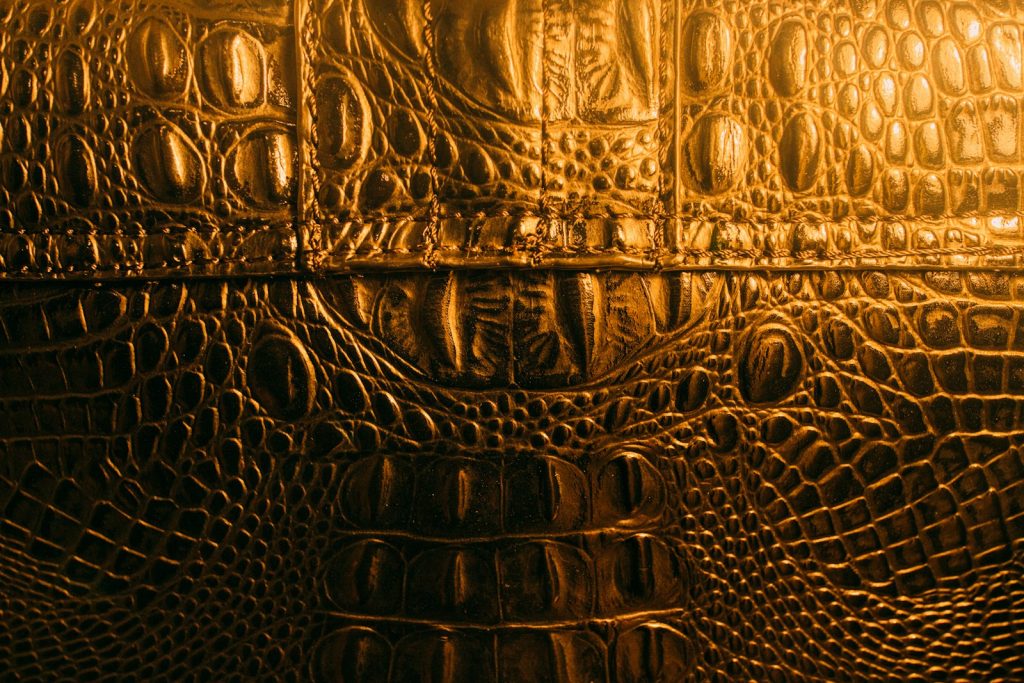
Honest sourcing note: We name every species accurately — saltwater crocodile (Crocodylus porosus), Nile crocodile (C. niloticus), American alligator (Alligator mississippiensis), caiman, reticulated python, monitor/ring lizard, ostrich and stingray — and never sell embossed calf as “exotic”. Most exotic leather is CITES-regulated (commonly Appendix II); legal cross-border trade needs export/import permits and source codes, and buyers are responsible for their country’s rules — this is general information, not legal advice; verify with your CITES Management Authority and customs broker. Prices, MOQ and lead times are indicative ranges (2025–2026), by quote. Luxury houses are referenced only as neutral examples — no affiliation. We are a B2B sourcing desk, not a tannery: we coordinate vetted, CITES-compliant suppliers.
Crocodile leather wholesale means buying raw or finished crocodilian skins in trade grades and export sizes, directly from tanneries and consolidators, for B2B production. At Exotic Leather Wholesale, we handle crocodile leather wholesale for two main CITES Appendix II species: Saltwater Crocodile (Crocodylus porosus) and Nile Crocodile (Crocodylus niloticus), sourced via vetted, CITES-compliant partners.
CITES-Compliant Crocodile Leather Wholesale: What You Actually Get
Most brands see “crocodile” as one line item; in reality, each order is a specific combination of species, size, cut, grade and finish, all under CITES controls.
We focus on two primary crocodile species for B2B clients:
– Crocodylus porosus – Saltwater crocodile, often called “porosus crocodile skin” or “saltwater crocodile skin” in trade.
– Crocodylus niloticus – Nile crocodile, frequently requested as “Nile crocodile leather” or simply “Nilo”.
Both are CITES Appendix II (farmed and ranched sources under quota). That means:
– Export needs CITES export permits from the producer country.
– Import usually needs CITES import permits or at least pre-clearance depending on your jurisdiction.
– Source codes (e.g. C, F, R, W, D) on the CITES permit indicate captive-bred, farmed, ranched or wild origin.
This page gives technical guidance for product development, buying and compliance discussions with your own CITES Management Authority and customs broker. It is general information, not legal advice.
Species We Supply: Porosus vs Nile vs Other Reptiles
Our role is to be a transparent, technically accurate sourcing desk — not a marketing agency. No mislabelling, no “exotic” fluff.
Core crocodile species
- Crocodylus porosus (Saltwater Crocodile)
– Trade use: top-tier luxury leathergoods and watchstraps.
– Key features: small, very regular belly tiles, fine grain, higher average unit value.
– Typical premium widths: 35–45 cm belly (adult); smaller juveniles for watch straps and small leathergoods. - Crocodylus niloticus (Nile Crocodile)
– Trade use: premium leathergoods, larger bags, belts, shoes.
– Key features: slightly larger and less “micro” belly tiles than porosus; still high-end; competitive price–quality ratio.
– Typical premium widths: 35–50 cm belly for bags; 28–34 cm for small leathergoods.
Other reptiles and exotics we handle (for comparison only)
We also source, via separate programs:
– Alligator mississippiensis – American alligator.
– Caiman – usually Caiman crocodilus fuscus in trade.
– Python reticulatus – Reticulated python.
– Monitor and ring lizard – e.g. Varanus salvator (water monitor) and ring lizard variants.
– Struthio camelus – Ostrich leather.
– Various stingrays (family Dasyatidae).
These are not crocodiles and are priced and graded differently. Just as importantly, we never call embossed calf “exotic”. If a skin is bovine with crocodile embossing, it is labelled exactly that.
This page, however, stays focused on porosus crocodile skin wholesale and Nile crocodile leather.
How Crocodile Skins Are Measured: Belly Width and Length
Crocodile skins are not sold like side leather by square foot. Industrial crocodile buying uses two key dimensions:
Belly width (the primary price driver)
– Measured across the belly, from flank to flank.
– Measurement point: typically between the second and third osteoderm-free row behind the front legs, depending on tannery spec.
– Taken in centimetres (cm), rounding convention agreed per supplier.
– Driving logic: the belly is the main usable area for most high-end products.
Typical belly-width groupings for porosus and Nile in fashion/leathergoods:
- 25–29 cm: small leathergoods, small strap applications.
- 30–34 cm: wallets, clutches, watch straps, small bags.
- 35–39 cm: mid-sized handbags, larger clutches.
- 40–45 cm: full-size handbags, larger panels.
- 46–50 cm+: large bags, boots, and cutting-intensive designs.
The “35–45 cm premium” band is the workhorse for bag makers: efficient cut yield vs unit price.
Overall length
– Measured from the tip of the nose to the end of the tail along the midline.
– Used more for technical pattern planning (e.g. full boot shafts, long belt strips) than for pricing.
– Tail portion is partly bony; belly and flanks are the most commercially valuable.
Back-cut vs belly-cut
Two primary cutting styles:
- Belly-cut (back scales intact)
– Cut down the belly; you open the belly and keep the back as a continuous plate.
– Yields: large, relatively flat belly area; ideal for most leathergoods.
– Most porosus and Nile fashion skins are belly-cut. - Back-cut
– Cut down the dorsal (back) line.
– Exposes belly as two large flaps; the back becomes two smaller strips.
– Used more when belly pattern is the primary visual feature for straps or panels, or in footwear with specific pattern layouts.
We will specify “belly-cut” or “back-cut” clearly in any quotation and packing list.
Grading: From Grade I to Grade IV
Every crocodile leather supplier uses a grading language. We work with a simplified, honest version aligned with how most serious tanneries classify:
Typical grading logic
Grading is based mainly on the belly area over a defined central rectangle, since that is where most premium panels are cut. Defects considered:
– Healed scars
– Open scars / holes
– Insect bites
– Grain damage
– Tanning defects (loose grain, grain burst, excessive wrinkles)
– Osteoderm prominence (on some species/lines)
A practical four-grade framework:
- Grade I (Prime)
– Virtually no visible defect in the main belly cutting area.
– Minor, hard-to-see issues allowed toward outer flanks only.
– Used for top-panel bags, hero pieces, and visible strap sections. - Grade II
– One or two small, manageable defects in or near the main cutting zone.
– Ideal where some avoidance is possible in pattern placement.
– Very common in high-end production where cost–yield balance matters. - Grade III
– Multiple defects in the central area, or one more-significant defect.
– Used for cutting into smaller pieces (cardholders, trim, gussets) or for parts not fully visible.
– Attractive for price-sensitive programs with creative patterning. - Grade IV / Utility
– Heavy marking, scars, or shaping issues.
– Suited to small components, tabs, inlays, and experimental or distressed-look product concepts.
Grading is always per skin, not per batch; mixed-grade lots should be clearly documented on the packing list.
Honest grading and defect images
For each shipment, we encourage:
– Representative photos of each grade band prior to packing.
– Clear grade labelling on each bundle and skin.
– Agreement on tannery grading standard in writing before P.O.
As lead editor, I will not “grade up” skins on paper. If a defect is there, it is described.
Porosus vs Nile: Species Comparison for Product Development
Below is a condensed comparison of porosus and Nile relevant to design and costing:
| Attribute | Crocodylus porosus (Saltwater Crocodile) |
Crocodylus niloticus (Nile Crocodile) |
|---|---|---|
| Usual trade positioning | Top-tier exotic for high-luxury leathergoods and straps | Premium exotic, slightly below porosus in price hierarchy |
| Belly tile size | Smaller, more regular tiles; “finer” visual grid | Slightly larger, more pronounced tiles |
| Typical premium belly width | 35–45 cm for handbags/small leathergoods | 35–50 cm for handbags/bigger items |
| Visual character | Refined, minimal; works well in polished and semi-matte | More assertive scale definition; suits both matte and glazed |
| Indicative finished price band (Grade I–II, 2025–2026) |
Higher: typically upper half of USD 10–35/cm range | Lower than porosus for comparable grade/size |
| Use by leading luxury houses | Flagship bags, small leathergoods, watch straps (examples only, no affiliation) |
Mainline bags, belts, footwear and SLPs (examples only, no affiliation) |
Both species can serve a luxury brand. The choice is a balance of:
– Visual identity.
– Target retail price.
– Expected defect tolerance.
– Available volume in consistent grading.
You can outline your intended product range and target retail brackets; we will respond with species/grade/size mixes that keep the look consistent while respecting your cost envelope.
Finishes: From Crust to Glazed
We coordinate a range of finish options with Indonesian and African partner tanneries:
Major finish categories
- Crust (undyed or basic dyed)
– For brands that want to control their own finishing or work with specialist finishers.
– Requires more technical capability at your end. - Matte / semi-matte
– Contemporary look; commonly used in high-luxury leathergoods.
– Shows natural grain and tile structure clearly. - Glazed (polished)
– High-shine, mirror-like finish from extensive plating and polishing.
– Traditional for certain iconic bag lines and small leathergoods. - Specialty finishes
– Nubuck/suede-like effects, metallics, two-tone hand tipping, etc.
– Higher development timelines and test batches; more variation between lots.
Consistent finish specification across P.O.s is critical. We recommend swatch approval and, if necessary, small pre-production lots before scaling.
Indicative Pricing: How Crocodile Is Priced Per cm
All crocodile pricing is by quote only, and varies by:
– Species: porosus vs Nile.
– Grade: I–IV.
– Belly width: each centimetre band has its own rate.
– Finish: crust vs full aniline vs glazed vs specialty.
– Order size and regularity.
– Exchange rates and logistics.
Based on trade information last verified June 2026, a realistic range for finished porosus and Nile (Grade I–II) is:
- Approx. USD 10–35 per cm of belly width, ex-tannery or FOB, depending strongly on the above parameters.
Example of how this is interpreted in practice (illustrative only, not a quote):
– A 38 cm Grade II Nile, standard matte, might sit somewhere in the lower–mid part of that range.
– A 40 cm Grade I porosus, top-matte or glazed, might sit in the upper part of that range.
You do not pay “per square metre”; you pay a belly-width band price multiplied by the number of skins.
To receive a firm quotation, send an RFQ detailing species, grades, sizes and finishes via plan your trip — we can also coordinate via WhatsApp for faster back-and-forth on specs and photos.
From Indonesia and Africa to Your Atelier: Sourcing Workflow
We are not a tannery. We are a B2B sourcing desk coordinating between:
– Licensed Indonesian and African farms/ranches.
– Vetted CITES-compliant tanneries.
– Freight forwarders, consolidators and customs brokers.
– Your atelier or production hub.
Typical sourcing steps
- Specification
You share:- Species: porosus or Nile (or other reptile for comparison).
- Cut: belly-cut or back-cut.
- Belly width bands (e.g. 30–34 cm, 35–39 cm).
- Grade mix (e.g. 70% Grade I–II, 30% Grade III).
- Finish (matte / glazed / crust, etc.).
- Target landed country and port/airport.
- Indicative pricing and availability check
We confirm:- Indicative price bands per cm and per grade.
- MOQ ranges (e.g. 20–50 skins per colour/size/grade combination is typical, but depends on tannery capacity).
- Lead times (usually quoted in weeks from deposit and spec finalisation; exact range varies by season and load).
- Sampling (optional but recommended)
For new programs, most clients:- Request 2–10 sample skins per spec and colour.
- Approve grading standard, finish and colour based on physical samples.
- Purchase order and production
After P.O. and deposit:- Tannery batches skins per agreed spec.
- We arrange mid-process checks (photos, measurements, random grading review).
- CITES documentation
For CITES Appendix II crocodiles (porosus and Nile), export normally requires:- CITES export permit from the exporting country’s CITES Management Authority.
- Correct source code (e.g. C, F, R, W, D) and scientific name (Crocodylus porosus or Crocodylus niloticus) on the permit.
- Accurate description and quantity of skins.
You remain responsible for:
- Checking if your importing country requires a CITES import permit.
- Any additional documentation (e.g. EU wildlife trade regulations, national permits).
- Working with your customs broker to pre-clear shipments.
This is general information only; for binding requirements, consult your CITES Management Authority and broker.
- Logistics and delivery
– Consolidation and packing at origin (careful folding and protection of finishes).
– Air freight or sea freight depending on lot size, value and urgency.
– Customs clearance and delivery to your designated warehouse or atelier.
Applications by Species, Size and Grade
Choosing the right mix is not only about price — it is about yield and visual consistency.
Handbags and leathergoods
– Flagship handbags (visible full panels)
– Species: typically porosus or high-grade Nile.
– Size: 35–45 cm belly width.
– Grade: majority Grade I, supported by Grade II for parts.
– Finish: matte or glazed depending on brand direction.
– Mainline handbags and SLGs
– Species: Nile crocodile is more common at scale, with occasional porosus capsules.
– Size: 30–40 cm for SLGs and small bags; 40–50 cm for larger silhouettes.
– Grade: controlled mix of Grade II and III, optimised for cutting plan.
Watch straps and small accessories
Many watch strap makers and small-accessory brands use:
– Species: both porosus and Nile, and also American alligator (Alligator mississippiensis) depending on story.
– Size: smaller widths like 28–34 cm where cost-per-skin is lower and yield per cm is high.
– Grade: more tolerance for Grade II and III because components are small.
Our sister site alligatorwatchstrap.com exists exactly for finished strap buyers; this crocodile page focuses on raw and finished skins for in-house production.
Bags, belts and footwear brands
For brands planning entire exotic programs:
– Nile crocodile often anchors the volume business as a nile crocodile leather supplier–style relationship: more accessible pricing, broader size spread.
– Porosus is positioned as limited, higher-priced capsules or top-line SKUs.
Our other finished-goods reference, crocodileleatherbags.com, shows the sort of products typically cut from these skins, though all B2B raw-skin sourcing is coordinated through Exotic Leather Wholesale.
Sourcing Ethos: Accurate Labelling and Realistic Expectations
A few non-negotiables define how we work:
Accurate species naming
– All P.O.s and invoices state full scientific names:
– Crocodylus porosus
– Crocodylus niloticus
– Alligator mississippiensis
– Caiman crocodilus fuscus
– Python reticulatus
– Varanus salvator (and other monitor/ring lizards as applicable)
– Struthio camelus
– “Crocodile” is never used to describe:
– American alligator.
– Caiman.
– Embossed bovine leather.
Real grades, real measurements
– Measurements in centimetres of belly width, not rounded up for marketing convenience.
– Grading described as Grade I–IV based on actual visible defects in the cutting area.
– We do not promise “all Grade I” at bargain prices; defect-free exotic skins command a premium by necessity.
CITES context, not promises
– We explain CITES categories and typical documentation sequences.
– We do not tell you what your national law “definitely” requires; that is the job of your CITES Management Authority and legal counsel.
– Species in Appendix I (such as some other crocodilians in specific regions) are treated with extra caution or not traded by us, depending on legal framework and sourcing clarity.
No brand or tannery name-dropping
– Luxury houses are referenced only as neutral examples of market practice.
– We do not publish or imply any special tannery or brand affiliation.
– You receive information and material on its technical merits, not on name recognition.
Lead Times, MOQs and Quality Control
Because we are coordinating across multiple partners, timelines and MOQs are always discussed per RFQ, but typical patterns exist:
Lead times (indicative)
Depending on:
– Current tannery load.
– Species and finish complexity.
– CITES and export administration timelines.
You might expect, as a broad range:
– Stock-based orders (existing colour/grade/size, limited quantity): shorter lead times, often in the lower end of a multi-week range once documents are ready.
– Custom colours or finishes: additional weeks for lab dips, approvals and full-batch finishing.
Lead times are always quoted as ranges, not guarantees, because CITES processing and logistics can introduce variability.
MOQs (indicative)
– For standard colours and finishes: tanneries often work with batch volumes, so plan for practical minimums such as 20–50 skins per colour/size/grade combination as a starting point, adjusted up or down by partner.
– For special finishes or rare colours: higher MOQs can apply to justify set-up costs.
Quality control checkpoints
We emphasise:
– Pre-shipment photo documentation and, where needed, video.
– Random measurement confirmation against agreed size bands.
– Spot grade-checking by reference to shared grading photos or physical references.
If you have your own in-house QC protocol, we can incorporate your checklists into our instructions to the tannery.
How to Start: From First RFQ to Consistent Supply
For a new crocodile leather wholesale program, a structured start avoids surprises:
- Define your product map
List the SKUs you intend to make — bags, straps, belts, SLGs — with projected annual volumes. - Choose species positioning
Decide how you want to position porosus vs Nile (e.g. “porosus only for halo products; Nile for core lines”). - Specify grades and tolerances
Indicate which components demand Grade I only and where Grade II–III is acceptable. - Send an RFQ
Use plan your trip to send:- Species, cuts, sizes and grades.
- Finish type and colour concept.
- Destination country and port.
- Target order window (e.g. Q4 2025, monthly call-offs, etc.).
We can continue the technical discussion and share media via WhatsApp for speed if you prefer.
- Run a pilot batch
Before committing to long-term supply, many clients run:- One pilot production batch.
- QC and production yield review in-house.
- Adjustments to size mix or grade mix based on real cutting data.
- Scale with feedback loops
As we learn your patterns and defect tolerances, we can refine buying instructions to tanneries, minimising mismatch and waste.
FAQs: Porosus & Nile Crocodile Leather Wholesale
What is the difference between porosus and Nile crocodile leather?
Porosus (Crocodylus porosus, saltwater crocodile) typically has smaller, more regular belly tiles and sits at the top of the price hierarchy for crocodilians. Nile (Crocodylus niloticus) has slightly larger, more pronounced tiles and is generally priced below porosus for comparable size and grade. Both are CITES Appendix II and both are used by premium and luxury brands; the choice is about look, positioning and budget.
How is crocodile leather priced per centimetre?
Each skin is placed into a belly-width band (for example, 35–39 cm), and that band has a price per cm that depends on species, grade and finish. The invoice value is the band rate multiplied by the belly width and the number of skins. For finished porosus and Nile in Grade I–II, indicative wholesale prices run approximately USD 10–35/cm (last verified June 2026), with porosus in the higher part of that range. Actual quotes depend on your exact spec and volume.
What do Grades I–IV actually mean for crocodile skins?
Grades describe the number and severity of defects in the main belly cutting area. Grade I is virtually free of visible defects there, Grade II has small, manageable issues, Grade III has more or larger defects suitable for smaller cuts, and Grade IV is heavily marked or flawed, used for utility or small components. Each tannery’s criteria differ slightly, so we align on a practical standard with photos and, where needed, samples.
Do I need a CITES permit to import crocodile leather?
For porosus and Nile crocodile (both CITES Appendix II), the exporting country must issue a CITES export permit. Many importing countries also require a CITES import permit or specific pre-clearance procedures. Requirements differ by jurisdiction and can change, so you must confirm details with your national CITES Management Authority and your customs broker. Our role is to ensure your supplier’s documentation is complete and accurate; this information is general and not legal advice.
Can you help me choose the right sizes and grades for my product line?
Yes. If you share sketches or technical specs of your bags, belts, straps or SLGs, we can recommend a mix of species, belly widths and grades that will give you reliable yields at your target cost level. Start by sending details and an RFQ via plan your trip; we can refine the specification with you over email and WhatsApp before any purchase order is placed.