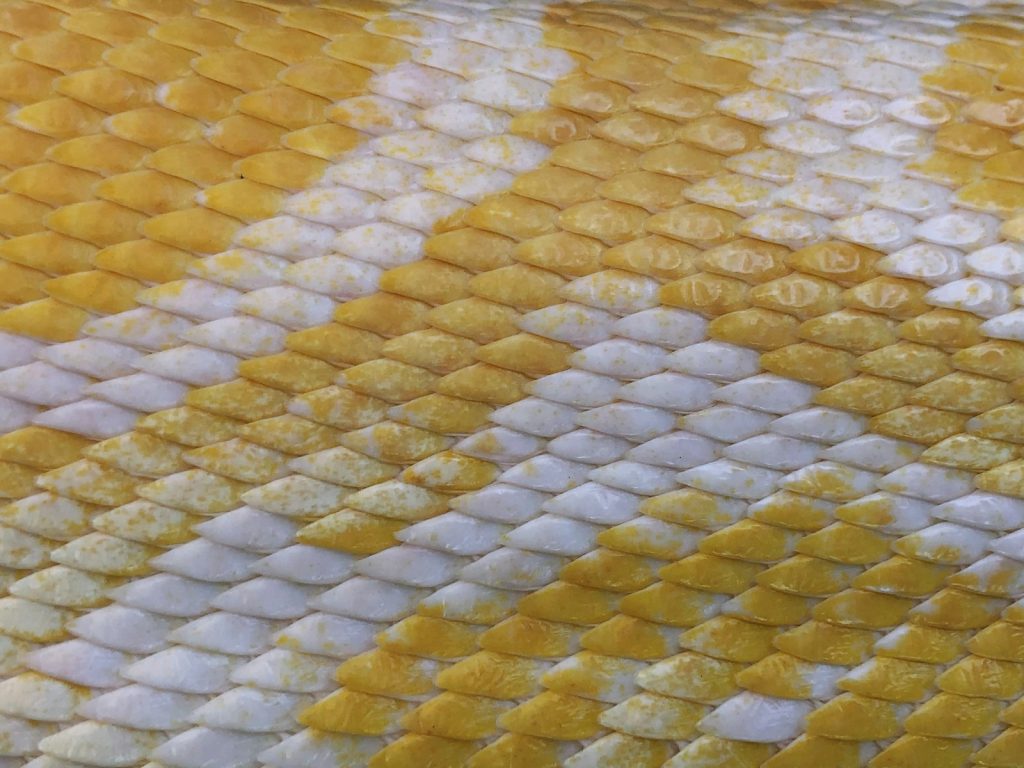
Honest sourcing note: We name every species accurately — saltwater crocodile (Crocodylus porosus), Nile crocodile (C. niloticus), American alligator (Alligator mississippiensis), caiman, reticulated python, monitor/ring lizard, ostrich and stingray — and never sell embossed calf as “exotic”. Most exotic leather is CITES-regulated (commonly Appendix II); legal cross-border trade needs export/import permits and source codes, and buyers are responsible for their country’s rules — this is general information, not legal advice; verify with your CITES Management Authority and customs broker. Prices, MOQ and lead times are indicative ranges (2025–2026), by quote. Luxury houses are referenced only as neutral examples — no affiliation. We are a B2B sourcing desk, not a tannery: we coordinate vetted, CITES-compliant suppliers.
Python back cut vs belly cut is simply about which side of the snake is opened when the raw skin is first cut: along the back (back cut) to expose the belly scales, or along the belly (belly cut) to expose the back pattern. That single decision changes the look, usable width, and best use of the finished python leather.
As exotic leather buyers, designers and production managers, you do not choose “python” in the abstract. You choose a specific species, cut, usable belly width, grade, finish and origin that fit a particular product. This page explains python back cut vs belly cut using real measurements, trade-standard grading, and CITES-compliant sourcing constraints.
1. First principles: what do “back cut” and “belly cut” actually mean?
In the python trade, “cut” describes how the raw skin is opened before tanning:
- Back-cut python leather – the skin is cut along the dorsal (back) line, so the leather opens to show the ventral/belly scales in the centre.
- Belly-cut python leather – the skin is cut along the belly, so the leather opens to show the dorsal/back pattern in the centre.
This python skin cut difference drives three things:
- The visual: large rectangular belly scales vs the more irregular diamond/back pattern.
- The usable width you can pattern-cut at the “sweet spot” (widest part of the skin).
- The products that make sense technically and aesthetically.
At Exotic Leather Wholesale, we handle both cuts in the main commercial python species from Indonesia, always sold by measured belly width and grade, not just by marketing names.
2. Species used for python back-cut and belly-cut leather
Most python skins for leather goods come from a few CITES-listed species. Accurate naming matters because pattern, width and legal controls differ.
- Reticulated python
- Malayopython reticulatus, CITES Appendix II. Wild-harvested (source W) and ranched (source R) in Indonesia. Very long skins, strong, with the familiar reticulated pattern.
- Burmese python
- Python bivittatus, CITES Appendix II. Farmed/ranched (often source C or F) in several Asian countries. Typically heavier and with a different, more blocky dorsal pattern than retic.
- Short-tailed/“Blood” python
- Python brongersmai and close relatives, CITES Appendix II. Shorter, wider skins often used where extra width is required.
Indonesia, where we source, is a major exporter of Malayopython reticulatus, both back-cut and belly-cut. For most fashion applications, you will be choosing between back-cut and belly-cut reticulated python, unless you have a specific request for Burmese or short-tailed python from other origins.
3. How python skins are measured in trade
Whatever the cut, commercial python is sold on three measurable axes:
- Belly width (cm) – measured straight across the widest usable part of the belly. This is the primary price driver.
- Usable length (cm) – typically measured excluding the head and tip-of-tail waste.
- Grade (I–IV) – based on size and location of natural and processing defects.
For back-cut skins the central belly is visually important, so small blemishes there will push a skin into a lower grade faster. For belly-cut skins attention goes to the dorsal pattern instead.
| Parameter | Typical range (back-cut) | Typical range (belly-cut) |
|---|---|---|
| Usable belly width band (cm) | 18–32 cm (selected lots to 36 cm) | 18–32 cm (selected lots to 36 cm) |
| Usable length band (cm) | 240–360+ cm, depending on lot | 240–360+ cm, depending on lot |
| Primary visual focus | Central belly scales | Central dorsal pattern |
| How width is quoted | Measured at belly “sweet spot” | Same: we still quote belly width |
Note: we always quote actual measured width on arrival in our Indonesian grading room, not nominal or “up to” widths.
4. Grade I–IV: how defects are assessed on back-cut vs belly-cut
Grading is visually similar across cuts, but the area that counts as “critical” changes:
- Grade I – essentially clean in the critical pattern area (belly centre for back-cut, dorsal centre for belly-cut). Only micro-defects at the very edge or tail.
- Grade II – small scars, holes or tanning marks in non-critical zones. Critical zone mostly clean and pattern continuous.
- Grade III – visible defects cross into the critical area; suitable for smaller cuttings, panels, or heavily structured pieces where you can place patterns around defects.
- Grade IV – heavy marking, staining or holes; mainly for small leather goods, trims, or experimental/washed finishes where irregularity is acceptable.
On back-cut belly-scales, common issues include:
- Natural scar lines across belly scales from wild capture.
- Defect clusters near the vent (toward tail).
- Scale lift or partial missing scales at the centre.
On belly-cut dorsal pattern, issues include:
- Broken or irregular diamond pattern from natural scars.
- Processing scratches running lengthwise along the back.
- Colour inconsistency on heavily finished skins.
Because the dorsal pattern is naturally more irregular, some buyers accept more apparent “visual noise” on belly-cut skins for fashion applications than they would for a very clean belly-scale presentation on a classic handbag or strap.
5. Visual and technical differences: python back cut vs belly cut
For design and prototyping, it helps to think objectively about what each cut offers.
5.1 Back-cut python: classic belly-scale look
Appearance
- Large, flat, more rectangular belly scales running down the centre.
- Dorsal pattern pushed to the sides; often partly trimmed away for narrow goods.
- Symmetry along the spine of belly scales is prized on handbags and larger panels.
Technical points
- The clean rectangular scale layout is easier to align on straight seams.
- More predictable scale behaviour with wear on smooth finishes.
- For many tanneries, back-cut is the dominant production, so colour/finish choices tend to be wider.
Typical uses
- Structured handbags and totes (central belly scales showcased).
- Wallet exteriors and small leather goods panels.
- Watch straps and narrow straps where a clean central scale run is visible.
5.2 Belly-cut python: dorsal/diamond pattern centre stage
Appearance
- Natural reticulated diamond or blotch pattern runs down the centre.
- Belly scales move to the sides and are less visually dominant.
- More visual “movement” – can look more casual or directional depending on colour.
Technical points
- Pattern placement becomes more critical: you may want specific motifs on flaps or vamps.
- On very narrow goods (e.g. straps), the pattern can look quite different depending on where you cut along the width.
- Some designers use belly-cut specifically to avoid the “very classic” belly-scale look.
Typical uses
- Sneaker and dress shoe uppers, where the dorsal pattern can be centred on the vamp.
- More casual or directional handbags and SLG lines.
- Ready-to-wear trims, yokes and panels where a more complex pattern reads better at distance.
6. Which cut for which product?
Below is a practical matrix for product development teams deciding between belly cut python leather and back-cut for a particular SKU.
| Product type | Recommended cut | Why |
|---|---|---|
| Classic women’s handbag (flap or tote) | Mostly back-cut | Central belly scales give a clean, recognisable python look and easier panel matching. |
| Directional or streetwear bag | Either, often belly-cut | Belly-cut dorsal pattern reads more graphic; good for bold colours and prints. |
| Belts | Back-cut preferred | Long, uniform belly-scale centre runs straight along the belt, easier to grade defects away from visible area. |
| Men’s wallets and SLG | Back-cut for classic, belly-cut for fashion | Back-cut gives neat central scales; belly-cut for collections seeking a more irregular pattern. |
| Luxury sneakers / casual shoes | Belly-cut common | Dorsal pattern is centred on the vamp or quarters; visually dynamic on footwear. |
| Dress shoe accents (strap, saddle, counter) | Either | Choice depends on brand styling; smaller components can be cut from either cut’s best areas. |
| Ready-to-wear panels (jackets, skirts) | Either, often back-cut | Back-cut is simpler for panel alignment; belly-cut for one-off or artisanal pieces. |
If you are planning a line across bags, belts and SLG, using a consistent cut and species makes colour and pattern continuity much easier at scale. To discuss options across multiple product categories, you can plan your trip to Indonesia’s tanneries with us or reach us on WhatsApp for an initial sourcing call.
7. Typical wholesale ranges: price, MOQ and lead-times
Exotic Leather Wholesale is a sourcing desk, not a tannery. We work with multiple Indonesian tanneries and exporters, so pricing is always by quote and depends on:
- Species and origin (e.g. wild reticulated vs farmed Burmese).
- Cut (back-cut slightly more common than belly-cut in some pipelines).
- Belly width bands.
- Grade (I–IV).
- Finish and colour (aniline, semi-aniline, nubuck, metallic, printed, etc.).
- Order size and selection requirements (e.g. 90% Grade I within a tight width band).
As of last verified June 2026, indicative ex-Indonesia wholesale ranges for finished reticulated python (Malayopython reticulatus) are:
- Back-cut, mixed natural colours, Grade I–II, 20–24 cm belly:
approx. US$40–70 per skin FOB Indonesia on commercial lots. - Back-cut, larger widths 26–30+ cm, Grade I:
often US$65–110 per skin, depending on selection tightness. - Belly-cut, similar width/grade bands:
typically in a comparable range; some specialty fashion finishes can be higher.
These figures are broad ranges only, for orientation. Actual quotes may fall outside depending on currency, specific tannery, finish complexity and your selection brief.
MOQ and lead-times (typical ranges, 2025–2026):
- Stock colours/finishes: 10–30 skins per colour/width/grade combination from available inventory, shipping in 1–3 weeks after payment and CITES paperwork clearance.
- Custom colours/finishes: 50–150 skins per colour as a common starting MOQ band; production plus export documentation typically adds 6–10 weeks, subject to tannery schedule and CITES permitting.
We do not publish fixed price lists because lots change at auction and from the field. For current availability and quotes by species, cut, width and grade, please share your spec via plan your trip or WhatsApp; we revert with options from multiple Indonesian partners.
8. CITES, legality and traceability
All commercial python species discussed here (Malayopython reticulatus, Python bivittatus, Python brongersmai) are CITES Appendix II-listed. That means international trade is allowed, subject to permits and non-detriment findings, as long as quotas and regulations are followed.
Key points for your compliance team:
- Source codes on permits will typically be:
- W – wild-harvested.
- R – ranched (raised from wild eggs or juveniles).
- C/F – bred in captivity or farmed (depending on jurisdiction and generation).
- Appendix II means export permits are required from the country of origin for skins and finished goods crossing borders, and many importing countries require corresponding import permits or documentary checks.
- Some markets also apply additional domestic rules (for example, stricter wildlife trade regulations or documentation for consumer transparency).
Exotic Leather Wholesale coordinates with licensed Indonesian exporters to ensure your shipments travel with the appropriate CITES paperwork and HS codes. We do not give legal advice; your compliance or legal department should always verify requirements with national CITES Management Authorities and customs before import.
9. Practical buying tips: back-cut vs belly-cut on your PO
To avoid surprises between your design spec and delivered skins, be explicit on your purchase order:
- State species and cut clearly:
e.g. “Reticulated python (Malayopython reticulatus), back cut” or “…belly cut”. Do not leave “python” generic if you care about pattern and scale layout. - Define belly width band:
e.g. “Selected 22–24 cm belly width” or “mixed 20–26 cm” depending on your product mapping. - Specify grade mix:
e.g. “80% Grade I, 20% Grade II acceptable” or “commercial mix Grade II–III for footwear cuttings”. - Indicate main product use:
Sharing whether skins are for bags, straps or shoes helps us reject skins that are technically unsuitable even if they meet formal grade. - Confirm finish and colour reference:
Natural, drum-dyed, semi-aniline, nubuck, metallic, printed, etc. The same cut looks very different under different finishes. - Align on defect tolerance:
For example, “no holes or scars across the central 10 cm belly line” on back-cut for bags, or “allow small dorsal scars near edges” on belly-cut for footwear.
If your design team is early in development and needs to see both cuts side-by-side, we can assemble mixed-cut sample assortments from Indonesian tanneries. Use plan your trip to request sample sets or a WhatsApp video call from the grading table, so your team can see real grading and cutting options in live time.
10. Summary: choosing between python back cut and belly cut
- Choose back-cut when you want:
- Classic belly-scale look in the centre of the panel.
- Cleaner, straighter visual lines for belts, straps and structured bags.
- Maximum predictability in pattern matching across panels.
- Choose belly-cut when you want:
- The natural dorsal/diamond pattern as the main feature.
- A more graphic, casual or fashion-forward appearance.
- Centred motifs on vamps, bag flaps, or statement panels.
Both cuts come from the same animal; the difference is how you frame and use what nature provides. If you give us your target retail, product mix and brand positioning, we can recommend species, cut, grade and finish combinations that make commercial sense for your line, not just for a single hero piece.
To brief a project, request quotes or schedule a sourcing visit in Indonesia, you can plan your trip and we will follow up on email or WhatsApp to map your requirements into real, measurable skins.
FAQs on python back cut vs belly cut
Is back-cut or belly-cut python more expensive?
Neither cut is automatically more expensive. Price is driven more by species, belly width, grade and finish. In some seasons, back-cut may be slightly higher where demand from bag makers is strong; in others, belly-cut in fashion finishes commands a premium. We quote both cuts side by side for your specification.
Can I make belts from belly-cut python?
Yes, but most buyers prefer back-cut for belts because the central belly scales give a clean, uniform run along the length. Belly-cut belts can look more irregular, as the dorsal pattern shifts across the narrow strap.
Do luxury brands use both back-cut and belly-cut python?
Major luxury houses use both cuts, depending on the collection. More classic, logo-forward handbags often rely on back-cut belly scales, while sneakers and directional fashion capsules may favour belly-cut dorsal patterns. We reference their use only as neutral examples, not as endorsements or affiliations.
Is belly-cut python weaker than back-cut?
No. Strength is primarily a function of species, tanning quality, thickness and how the skin is skived and constructed. Back-cut and belly-cut are simply different orientations of the same dermal structure from the same species.
How do I specify python cuts correctly for CITES permits?
CITES permits list the scientific name, source code, quantity and description (e.g. “tanned skins”), but not usually “back-cut” or “belly-cut”. You should specify species and cut clearly on your internal POs and commercial invoices, and coordinate with your exporter so that permit descriptions and HS codes match customs expectations. Always confirm details with your national CITES Management Authority; our information is general and not legal advice.