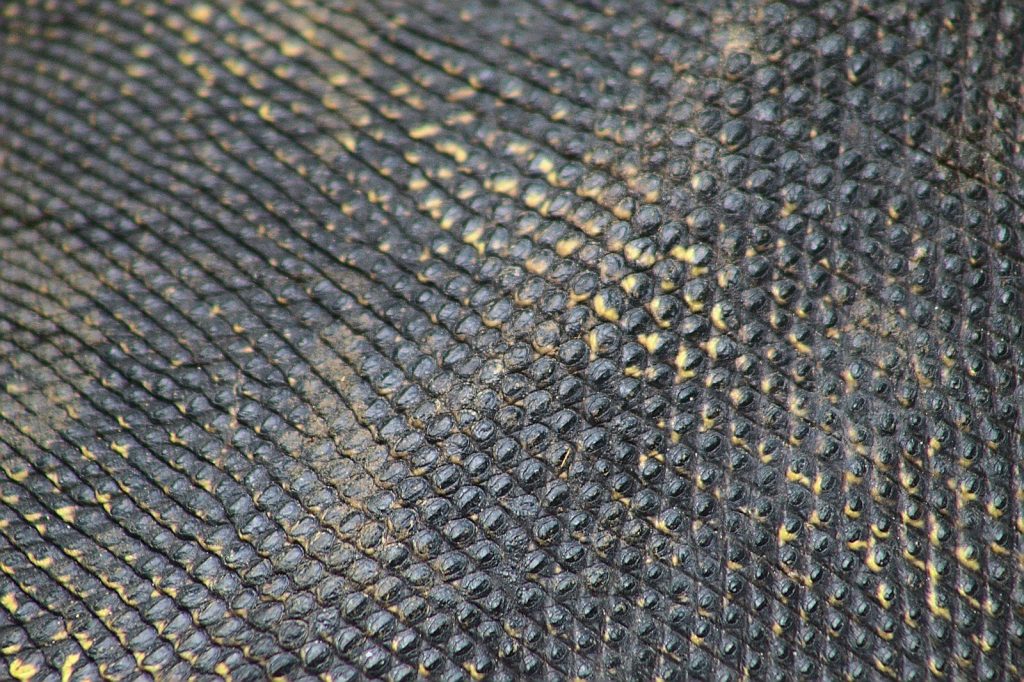
Honest sourcing note: We name every species accurately — saltwater crocodile (Crocodylus porosus), Nile crocodile (C. niloticus), American alligator (Alligator mississippiensis), caiman, reticulated python, monitor/ring lizard, ostrich and stingray — and never sell embossed calf as “exotic”. Most exotic leather is CITES-regulated (commonly Appendix II); legal cross-border trade needs export/import permits and source codes, and buyers are responsible for their country’s rules — this is general information, not legal advice; verify with your CITES Management Authority and customs broker. Prices, MOQ and lead times are indicative ranges (2025–2026), by quote. Luxury houses are referenced only as neutral examples — no affiliation. We are a B2B sourcing desk, not a tannery: we coordinate vetted, CITES-compliant suppliers.
Water monitor lizard leather is the tanned and finished skin of Varanus salvator, a large semi‑aquatic lizard native to South and Southeast Asia. In the trade, water monitor lizard leather is valued for its small, even scales, good cutting yield on small goods, and relatively accessible pricing compared with crocodile or python.
What is Water Monitor Lizard Leather (Varanus salvator)?
Water monitor (Varanus salvator) is one of the most widely used lizard species in the leather trade. Indonesia, along with a few other Southeast Asian countries, is a major exporter of legally harvested, CITES‑regulated varanus salvator skin.
Key characteristics of genuine Varanus salvator skin:
– Species: Varanus salvator (no trade name should replace the scientific name)
– Typical raw skin length: ~70–130 cm for commercial grades
– Scale pattern: Small, fairly regular scales; belly area is smoother and more uniform
– Thickness (crust/finished): Approx. 0.5–1.0 mm depending on area and finishing
– Typical use: Small leather goods (SLG), watch straps, footwear panels, light leather goods where thin, fine scale texture is desired
For many brands, water monitor sits between smaller lizards (e.g., Varanus bengalensis) and higher‑priced reptiles such as python and crocodilian in terms of cost and “exotic” visual impact.
Species Identification & Honest Labeling
Correct species naming is non‑negotiable in professional sourcing. Many consumer‑facing products are marketed simply as “lizard skin” without a species; in your technical specs and bills of material, you should insist on scientific names.
Correct species name
– Scientific name: Varanus salvator
– Common trade descriptions: Water monitor, water monitor lizard
– Incorrect / vague descriptions to avoid in B2B specs:
– “Dragon leather”
– “Embossed lizard” (if it is actually embossed cowhide, it must not be sold as lizard)
– “Monitor leather” without specifying species
If the material is embossed bovine or goat, it must be described as such (e.g., “cowhide with lizard embossing”), not as “lizard” or “monitor”.
Visual identification clues
At the crust or finished stage:
– Belly zone: Smaller, flatter scales with relatively consistent shape
– Flanks: Scales become slightly larger and more irregular
– Head/neck area: Often trimmed off or heavily downgraded for defects and inconsistent scale pattern
– Tail: Narrow, with more elongated scales; often used only for small parts or not at all in luxury applications
If you are unsure whether a skin offered as “varanus salvator” is genuinely that species, request:
– High‑resolution close‑ups of belly and flank scales
– Overall skin layout (belly side up)
– Export documentation referencing the species name
CITES & Legal Sourcing (General Information Only)
Varanus salvator is a CITES Appendix II species. Trade is allowed but controlled through permits and quotas. This section is for general information only and does not constitute legal advice; always confirm current rules with your national CITES Management Authority and customs broker.
Key points for varanus salvator skin:
– CITES Appendix: II
– Typical source codes you may see on permits:
– W – Wild
– R – Ranched (e.g., hatchlings collected and raised in captivity then harvested)
– C/F/D – Various forms of captive breeding; less common for this species in Indonesia
– Documents normally required for export from Indonesia:
– CITES export permit naming *Varanus salvator*
– Other national wildlife and trade licenses depending on the exporter
At Exotic Leather Wholesale we operate as a sourcing desk, not as a tannery. We work with established Indonesian varanus salvator tanneries that export under valid CITES documentation. Your import obligations, tariffs, and any additional permits depend on your country; verify with your customs agent and CITES authority before committing to production timelines.
Back‑Cut vs Belly‑Cut Monitor Lizard Skins
For water monitor lizard, you will encounter both back‑cut and belly‑cut skins. The cut orientation dictates where the most usable belly area sits in the finished skin.
Back‑cut (belly intact)
– The cut runs along the dorsal (back) side of the animal.
– Result: Belly is intact and forms a wide, continuous panel.
– Best for:
– Watch straps and bracelets
– SLG panels (wallet exteriors, cardholders)
– Small bag panels where an uninterrupted belly pattern is required
Belly‑cut (back intact)
– The cut runs along the belly.
– Result: The back pattern is continuous; belly is split.
– Best for:
– Applications where a more “wild” dorsal pattern is desired
– Lower‑price volume items where consistency is less critical
For most luxury‑oriented monitor lizard leather uses, buyers specify back‑cut Varanus salvator and focus on the clean belly area for visible surfaces.
Grades I–IV: How Water Monitor Lizard Leather is Sorted
Grading criteria vary by tannery, but professional Indonesian monitor lizard operations commonly use a 4‑grade structure for fashion‑grade skins.
Below is an indicative grading logic we apply when we inspect Varanus salvator skin for clients.
Grade I (Premium)
– Defect‑free or near‑defect‑free belly over the main cutting zone
– Very small, occasional natural marks allowed near edges
– Good, even dye penetration
– Full usability for visible panels
Typical usage:
– High‑end watch straps
– SLG for premium lines
– Visible bag panels on higher‑priced collections
Grade II (Standard commercial good)
– Minor scars, healed marks, or small holes on belly, but avoidable in pattern cutting
– Some minor edge defects or dye variation
– Still yields high percentage of clean pieces
Typical usage:
– Mid‑range small leather goods
– Footwear uppers/panels where small flaws can be placed outside the visible area
– Lower‑visibility bag components
Grade III (Utility / more visible defects)
– Noticeable marks or scars crossing parts of the belly
– More edge damage, brand marks, or insect bites
– Good for smaller cut pieces where defects can be excluded
Typical usage:
– Belt loops, zipper pulls, tabs
– Small decorative inlays
– More price‑conscious product lines
Grade IV (Heavy defects / experimental)
– Larger and/or multiple defects across the belly
– May include holes, deep scars, or strong colour inconsistencies
– Purchased mainly for:
– Experimental design use
– Non‑visible components
– Price‑driven applications
For investment‑grade small goods with tight tolerances (watchstraps for example), we recommend Grade I or carefully selected Grade II back‑cut skins only.
Measurements: Belly Width, Usable Length, and Yield
Accurate measurements matter more than any marketing description. For water monitor lizard, two values are especially important:
1. Belly width at the widest usable point
2. Usable length (excluding tail tip and heavily defective areas)
How we measure Varanus salvator skins
– Belly width:
– Measured across the belly at the widest, clean point, perpendicular to the spine
– Given in centimetres
– Total length:
– From neck/shoulder area to tail tip, belly side
– Usable length for fashion:
– Typically excludes the last 10–20 cm of tail where the skin narrows and may be too small for panel cutting
Many Indonesian tanneries sort water monitor skins into width bands (for example, 18–20 cm, 20–22 cm, etc.). Pricing is usually quoted per piece, sometimes with premiums for larger widths.
Indicative measurement ranges
Below is a simplified, indicative reference. Exact ranges depend on the batch and the tannery.
| Parameter | Typical Range (Fashion-Grade Varanus salvator) |
|---|---|
| Belly width (widest point) | 16–24 cm |
| Total skin length | 70–130 cm |
| Usable length for SLG panels | 50–90 cm (central section) |
| Typical thickness (finished) | 0.5–1.0 mm |
For watch straps, brands often need consistent belly width across a production lot so that scale size and alignment stay uniform between strap sizes and models.
Monitor Lizard Leather Uses: What Varanus salvator Suits Best
Because varanus salvator skin is thin, flexible, and offers fine scale detail, it sits in a specific niche between more robust reptiles and embossed bovine.
Small Leather Goods (SLG)
Monitor lizard leather is widely used for:
– Wallet exteriors and interiors
– Cardholders
– Coin purses
– Passport covers
– Slim folios and document sleeves (using multiple panels)
Advantages:
– Good cutting yield from each skin for small panels
– Fine scales that read “exotic” without being loud
– Sits at a lower price point than crocodile or alligator, which allows more commercial price ladders
Watch straps and bracelets
Varanus salvator is a well‑established material for watch straps:
– Uniform belly scales work well in narrow widths
– Thin structure reduces bulk under deployant clasps
– Various luxury watch brands have used monitor lizard historically (as a neutral example, similar textures appear in limited‑run strap collections, without implying any affiliation to our company)
Important technical points:
– Back‑cut, Grade I–II, belly portion only, is recommended
– Consistent belly width and grade across the order is critical
– For higher‑end horology, some clients require “belly only” selection with tight defect tolerances
Footwear
Water monitor lizard can be used for:
– Vamp and quarter panels
– Tongues or decorative overlays
– Trims on sneakers and dress shoes
Because the skins are relatively small compared to crocodile flanks, monitor lizard is less suited for very large continuous panels, but works well in multi‑panel shoe patterns.
Small bags and trims
For handbags and leather goods lines, varanus salvator is often used:
– As flap or pocket accents
– For handle wraps
– As gusset or piping overlays
– On micro‑bags or clutches where panel size is manageable
Many brands combine monitor lizard with main body materials such as calfskin or goat, using lizard for visual interest with controlled cost.
Finishes, Colours, and Tannages
Indonesian tanneries working with water monitor lizard offer a wide range of finishes. Exotic Leather Wholesale does not operate its own tannery; we coordinate with multiple finishing partners to meet project‑specific requirements.
Typical finishing options for varanus salvator skin include:
Crust and semi‑finished
– Crust (undyed, neutral): For brands that prefer to finish in‑house or at a finishing partner in Europe or elsewhere
– Aniline‑dyed crust: For later finishing, ironing, or glazing
Standard finished colours
– Classic blacks and browns
– Neutrals (tan, cognac, grey)
– Fashion colours on request (MOQs apply)
Surface finishes
– Matte / low‑sheen: Popular for contemporary SLG and watch straps
– Semi‑gloss: Traditional, slightly polished appearance
– High‑gloss / patent‑like: Less common but possible with more layers and care
– Hand‑finished / antiqued: Dyed or hand‑wiped to emphasise scale edges
Finishing choices will impact both cost and lead‑time, especially for custom colour standards that require lab dips and client approval.
Indicative Wholesale Pricing & MOQs (2025–2026)
All pricing here is indicative only, based on recent sourcing desk quotes last verified June 2026. Actual quotes depend on:
– Order quantity and repetition
– Grade mix and width band
– Finish, colour, and required selection (e.g., belly‑only)
– Logistics and CITES documentation handling
For fashion‑grade Indonesian Varanus salvator:
– Grade I back‑cut, standard colours:
– Approx. US$20–40 per skin for typical width bands
– Grade II back‑cut, standard colours:
– Approx. US$15–30 per skin
– Grade III–IV / mixed lots:
– Approx. US$8–18 per skin
Custom colours, special finishes, or strict selection criteria normally add a premium.
Typical MOQs we see from Indonesian tanneries (via sourcing desk orders):
– Stock colours / standard finishes:
– Often 30–50 skins per colour as a practical minimum for efficient pricing
– Custom colours / development:
– 50–100 skins per colour is a more realistic starting point, especially for repeated runs
For brands testing a new line, we often structure:
– Small pilot orders (e.g., 20–40 skins) with standard colours and grades, then
– Scaled orders once prototypes are approved and sales projections confirmed
To request a tailored quote for your monitor lizard leather project, specifications, and target price bracket, you can plan your trip through our sourcing desk or reach us via WhatsApp for detailed, line‑by‑line planning.
Working with Exotic Leather Wholesale as Your Sourcing Desk
Exotic Leather Wholesale is a B2B sourcing and grading specialist. We are not a tannery; instead, we coordinate with vetted Indonesian tanneries and export partners on your behalf.
For water monitor lizard leather (Varanus salvator), our role typically includes:
Specification and grading alignment
– Translating your design brief into concrete specs:
– Species: Varanus salvator
– Cut: Back‑cut vs belly‑cut
– Width band: e.g., 18–20 cm, 20–22 cm
– Grade: I–IV, plus any “belly‑only” or colour‑uniformity requirements
– Reviewing pre‑shipment photos, videos, or in‑person batches for:
– Defect level against the declared grade
– Realistic belly widths
– Consistency of finish and colour
Supplier and batch selection
– Matching your requirement (e.g., watch strap belly Grade I) to the tanneries and traders with the appropriate stock or production capacity
– Verifying availability against your timelines and projected repeats
– Consolidating skins from different batches where necessary while maintaining spec consistency
CITES and export coordination
– Aligning with Indonesian exporters who hold valid wildlife and trade licenses
– Coordinating the issuance of CITES Appendix II export permits naming *Varanus salvator*
– Scheduling tanning, finishing, packing, and export timelines
You remain responsible for compliance with import rules in your jurisdiction; we help you align the upstream side with your regulatory expectations.
Who we work with
We primarily serve:
– Independent leather goods ateliers
– OEM/ODM manufacturers for luxury and premium brands
– Watch strap makers and horology supply specialists
– Footwear makers using exotics in selected lines
If you also work with other exotics (crocodile, python, stingray, etc.), our team can align varanus salvator sourcing to your broader material library. For more detail on other species and categories, refer to the relevant guides on exoticleatherwholesale.com and our sister resources.
How to Brief a Varanus salvator Order Properly
A clear technical brief reduces grading disputes and production surprises. For water monitor lizard leather, a good RFQ should include:
1. Species: Varanus salvator (water monitor lizard)
2. Cut: Back‑cut or belly‑cut
3. Target belly width band: e.g., 18–20 cm, 20–22 cm
4. Grade: I, II, III, or specified mix (e.g., 70% Grade I, 30% Grade II)
5. Colour / finish:
– From standard colour card, or
– Custom colour with reference (Pantone, leather swatch, or sample product)
6. Intended use:
– Watch straps, SLG, footwear panels, bag panels, etc.
7. Quantity:
– Number of skins per colour, and expected repeat volumes
8. Regulatory / sourcing preferences (if any):
– Preference for certain source codes (W/R)
– Specific country of origin requirements
The more precisely you can define these, the more accurate — and comparable — your quotes will be across suppliers.
If you’d like help translating your design intent into concrete species/grade/measurement language for Indonesian producers, you can plan your trip with our team; we also answer detailed briefs and adjustments via WhatsApp for faster iteration.
Frequently Asked Questions about Water Monitor Lizard Leather
Is water monitor lizard leather durable enough for everyday wallets?
Yes, Varanus salvator skin is suitable for everyday wallets and small leather goods, provided it is correctly tanned and finished. It is thinner than cowhide, so many ateliers back it with calf or goat lining to add structure and improve edge finishing. Abrasion resistance is acceptable for normal use, but care instructions should tell end‑customers to avoid prolonged scraping against rough surfaces.
How does Varanus salvator compare in price to crocodile or python?
As of quotes last verified in June 2026, Indonesian water monitor lizard skins are generally more affordable per piece than fashion‑grade crocodile and often overlap with, or sit slightly below, many python price bands. Overall project cost also depends on yield; a single crocodile flank can yield many panels, whereas a monitor lizard skin yields smaller panels and multiple skins are needed for bigger items.
Can I import water monitor lizard leather into the EU or US?
In many cases, yes, as Varanus salvator is a CITES Appendix II species and not Appendix I. However, import is regulated and requires valid CITES export permits and, in some jurisdictions, CITES import permits or specific declarations. Local or regional restrictions can change, and some brands adopt stricter internal policies than the law. Always confirm with your CITES Management Authority and customs broker; this page is general information only, not legal advice.
What is the minimum order quantity (MOQ) for custom colour monitor lizard leather?
For Indonesian tanneries that we work with, realistic MOQs for custom colours on Varanus salvator are typically 50–100 skins per colour, depending on grade, width, and finish. Smaller pilot runs may be possible with stock colours or by piggy‑backing on existing production, but unit pricing will usually be higher.
How do I ensure I am getting genuine Varanus salvator and not embossed cowhide?
Insist on the scientific name in all documentation, request high‑resolution photos or physical samples, and check that your supplier provides CITES paperwork that lists Varanus salvator as the species. Embossed cowhide has a repeating, mechanical pattern and a thicker, more uniform cross‑section, whereas genuine monitor lizard shows natural variation in scale size and shape, and much thinner overall thickness. Working through a sourcing desk that inspects and grades skins before shipment further reduces the risk of mislabeling.