Honest sourcing note: We name every species accurately — saltwater crocodile (Crocodylus porosus), Nile crocodile (C. niloticus), American alligator (Alligator mississippiensis), caiman, reticulated python, monitor/ring lizard, ostrich and stingray — and never sell embossed calf as “exotic”. Most exotic leather is CITES-regulated (commonly Appendix II); legal cross-border trade needs export/import permits and source codes, and buyers are responsible for their country’s rules — this is general information, not legal advice; verify with your CITES Management Authority and customs broker. Prices, MOQ and lead times are indicative ranges (2025–2026), by quote. Luxury houses are referenced only as neutral examples — no affiliation. We are a B2B sourcing desk, not a tannery: we coordinate vetted, CITES-compliant suppliers.
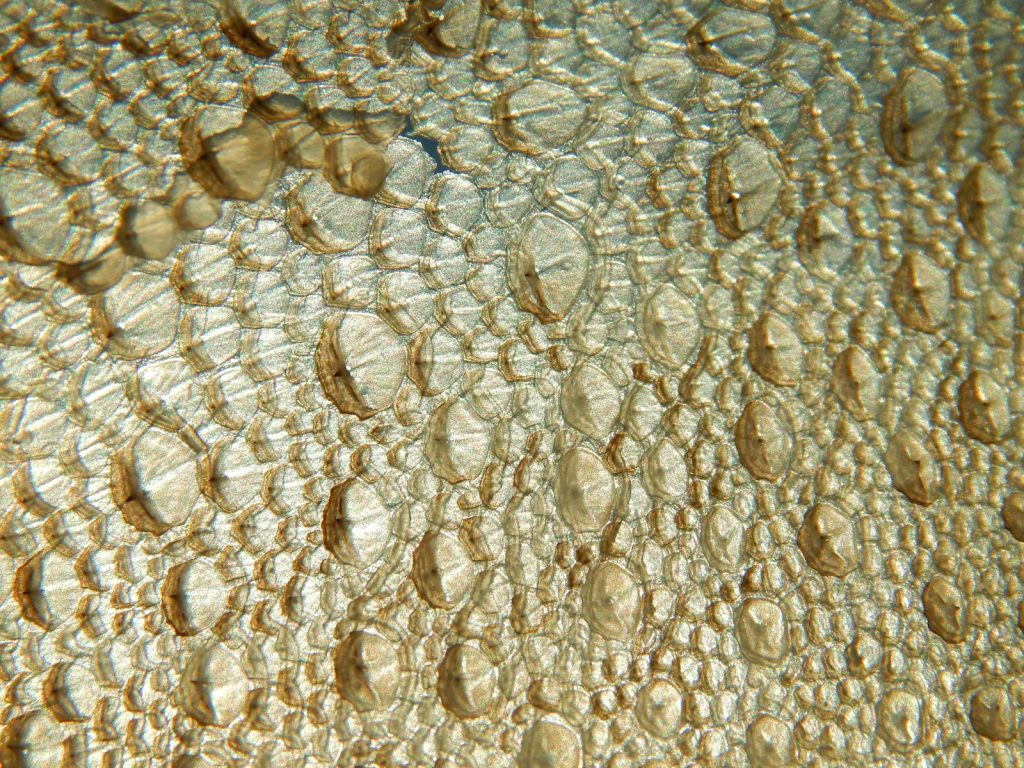
Stingray leather shagreen is the tanned and finished skin of true rays, prized in leather goods for its granular texture and glass-hard, polished eye. In the trade, “shagreen” refers specifically to this pebbled, calcified surface on stingray or related ray species, not to embossed cowhide or synthetic imitations.
What is shagreen? Clear definition for buyers
Historically, “shagreen” described ray skin (and sometimes shark) with the natural calcified nodules left visible or polished. Today in B2B sourcing, the term is used in three ways:
- True stingray leather shagreen: genuine ray skin (order Myliobatiformes), tanned and finished with intact or slightly buffed nodules.
- Polished stingray skin: same material, but the nodules are buffed/ground and often high-gloss finished for a smoother feel and strong reflection.
- “Shagreen-embossed” cowhide or PU: regular leather or synthetic, press-embossed with a pebble pattern; not exotic, not CITES, not stingray.
For Exotic Leather Wholesale, “shagreen” always means genuine stingray or ray skin by scientific name, never embossed lookalikes. Embossed cow or PU can be sourced separately and must be labeled as such.
Species: what stingray leather shagreen really is (and isn’t)
Most commercial stingray leather is harvested from meat fisheries in Southeast Asia. Skins are a by-product, not primary catch. Typical species include:
- Neotrygon kuhlii (Bluespotted maskray) – small to medium skins, fine pebble pattern, common in Indonesian and Thai production.
- Pastinachus spp. (Whiptail rays) – generally larger panels, slightly coarser nodules; used for bigger accessories and panels.
- Other local Myliobatiformes – trade often uses generic “stingray” naming, but sourcing documents should specify the landed species where possible.
Two critical compliance points:
- Correct naming – Genuine stingray ≠ embossed bovine. For B2B contracts and labelling, you should specify “stingray leather (Neotrygon / Pastinachus spp.)” or similar, and keep “shagreen” as a finish/colloquial descriptor.
- CITES status – As of mid-2026, the main Southeast Asian stingray species used for leather are not listed on CITES Appendices I or II. That can change; always verify current listings with your national CITES Management Authority or a qualified compliance adviser. This page is general information, not legal advice.
Anatomy of stingray leather: structure, “eye”, and panels
Stingray skin behaves very differently to bovine or reptile:
- Calcified surface: The dermal denticles (hard “pearls”) are mineralized. They don’t stretch like grain leather. This creates abrasion resistance but limits workability.
- The “eye”: The white oval in the middle of the back is a dense cluster of larger denticles. On polished stingray skin it becomes a bright, reflective feature. It’s usually centered on belts, wallets and small leather goods for visual impact.
- Panel shape: Ray skins are rounder/diamond-shaped, not long like bovine sides. Effective usable panel is limited; pattern efficiency matters more than on cowhide.
- Thickness: After tanning, commercial stingray leather is often 0.8–1.2 mm on finished goods. Raw crust can be thicker, then split or shaved to customer spec within technical limits.
Forms: raw, wet-blue, crust, finished stingray
As a sourcing desk, we see stingray traded in four main forms. Understanding the differences helps you specify the right stage for your supply chain.
| Form | What it is | Typical buyer | Key considerations |
|---|---|---|---|
| Raw salted skin | Fresh skins preserved in salt, not tanned | Tanneries with their own beamhouse | Cheapest per piece; requires full tannery capability & waste handling |
| Wet-blue | Chrome-tanned, wet, blue-grey colour | Tanneries/finishers; some large OEMs | Stable intermediate; still needs retan, dye, and finishing |
| Crust | Tanned, dried, usually undyed or light base dye | Finishers & brands with finishing partners | Good for brands wanting control of colour/finish; needs finishing line |
| Finished | Fully dyed, finished, graded stingray leather | Brands, ateliers, factories | Ready for cutting; highest price per piece, lowest process risk |
Most fashion and leathergoods brands should specify finished stingray leather unless they own or closely control a finishing line and QC.
Finishes: from raw texture to polished stingray skin
Stingray finishing is a specialized craft. The same skin can yield very different looks:
1. Raw / natural grain shagreen
- Denticles left largely intact, minimal buffing.
- Matt to satin topcoat, often with more “grainy” handfeel.
- Shows irregularity and natural pebble pattern; less “shine” than polished stingray skin.
This suits clients who want a more organic look or a historic “sword handle” aesthetic.
2. Polished stingray skin
- Denticles are ground and buffed to a smooth, glassy surface.
- Eye area is often especially polished to a bright, almost gemstone-like oval.
- Finish can be high-gloss, semi-gloss, or even metallic/pearlized.
This is the finish most people picture when they say “stingray shagreen” for belts, clutches, and watch straps.
3. Dyed-through vs surface-dyed
- Dyed-through: Colour penetrates deeper. Cut edges are closer to upper colour, better for exposed edges and high wear.
- Surface-dyed / pigmented: Heavier pigment or effect layers on top. Strong colour and effects (metallic, gradients) but cut edges may show a lighter core.
When you RFQ, specify:
- Natural vs polished finish;
- Matt / semi-gloss / gloss;
- Solid, metallic, pearl, or special effect;
- Target thickness range.
Grades and measurements: how stingray is actually sold
Measurement:
Most Indonesian stingray skins are sold per piece, not by square foot, due to irregular usable area and the focus on central-eye placement. For large volume furniture/panel work, some tanneries will convert to sq. ft. equivalents, but commercial practice in Java remains “per skin, by size band and grade.”
Typical size banding (indicative):
- Small: approx. 18–24 cm width
- Medium: approx. 24–30 cm width
- Large: approx. 30–36 cm width
- Extra large: 36 cm+ when available
Widths are usually measured across the widest usable point of the body, excluding tail.
Grading:
Every tannery applies its own grading system, but a practical working framework is:
- Grade A / 1
- Clean eye, minimal scars or blemishes, consistent pebble pattern, optimal for premium belts, small leathergoods, and visible panels.
- Grade B / 2
- Minor scars or healed marks away from eye, small irregularities; suitable for mid-tier products or where cutting can avoid flaws.
- Grade C / 3
- More visible defects, irregular eye, or edge damage; better for small parts, covered components, or experimental work.
With stingray, eye quality and central body area drive the grade more than tail or extreme edges. Ask for each tannery’s grading photos or visit the selection line if you are committing to program volumes.
Price ranges, MOQs, lead-times (2025–2026 indicative)
Based on current Indonesian and regional trade (last verified June 2026), indicative wholesale ranges for finished stingray leather shagreen are:
- Standard colours, finished skins (black, dark brown, deep navy, etc., polished or semi-polished):
Approx. US$25–45 per skin ex-works, depending on size band and grade. - Fashion colours / metallic / pearl:
Approx. US$35–65 per skin ex-works, reflecting extra finishing steps, more rejects, and batch setup.
Some European or Japanese importers and luxury-oriented tanneries will price significantly above these Indonesian-origin ranges, especially for tight QC and branded supply chains. Treat the figures above as a baseline for Java and regional production, not a global retail benchmark.
Minimum order quantities (MOQ) for B2B:
- Stock colours (classic black, dark brown, navy from Indonesian tanneries): often 20–50 skins per colour / shipment as a practical commercial minimum, with mixed grades possible.
- Custom colours or effects: more commonly 80–200 skins per colour, depending on tannery, finish chemistry, and desired consistency.
- Proto / sampling: many tanneries will allow 5–10 skins for lab dips or pilot runs, usually at a surcharge or linked to a main order.
Lead times (assuming raw material already in-house and CITES not required for the species):
- From existing stock shades: 1–3 weeks to pick, trim, and ship, depending on QC and export admin.
- Repeat custom colours (formula already approved): typically 4–6 weeks production time once confirmed.
- New colour development (lab dip + approval): 6–10 weeks from brief to ship-ready, assuming 1–2 rounds of lab dips.
Our role at Exotic Leather Wholesale is to translate these ranges into an exact quote for your spec and delivery window. For a live RFQ, plan your trip with our sourcing desk by email or WhatsApp; we can walk through current market levels and batch options.
Indonesia vs France/Italy/Singapore: capability comparison
Indonesia is one of the main hubs for stingray leather shagreen, particularly Java and surrounding islands, where stingray fishing and tanning are established. Here’s how capability generally compares to other regions:
Indonesia (Java-centric production)
- Strengths:
- Proximity to raw material; strong supply of small-to-medium skins.
- Deep craft history in polishing and eye presentation.
- Competitive cost structure for volume orders.
- Flexibility on OEM/private label finishing.
- Constraints:
- More variation batch-to-batch than some EU/Japanese lines.
- Documentation/QC frameworks vary; choosing the right tannery matters.
France & Italy
- Strengths:
- Very tight colour and gloss control, high repeatability.
- Strict QC and documentation; aligned to major luxury brand specs.
- Advanced special finishes for haute horlogerie and maroquinerie.
- Constraints:
- Higher labour and compliance costs; per-skin pricing can be multiples of Indonesian ex-works.
- Some operations rely on imported crust/wet-blue, adding logistics layers.
Singapore & regional finishers
- Strengths:
- Specialist finishing and colour labs, sometimes working on Indonesian crust.
- Efficient logistics and finance environment.
- Constraints:
- Limited raw tanning base; tends to be part of a multi-country supply chain rather than full-cycle.
As a sourcing desk, we use Indonesian tanneries as a first port of call for cost-effective, CITES-appropriate stingray, and then match or supplement with EU/other capacity when a client’s QC, brand story, or origin requirements demand it.
Applications: who buys stingray leather and why
Stingray is a niche, high-character leather. Buyers accept higher material cost and cutting loss because the finished goods offer:
- Visual identity – The granular surface and eye are immediately recognisable, used by several luxury houses and independent makers as a signature accent.
- Abrasion resistance – The hard denticles resist surface scuffing better than most reptile and bovine leathers.
- Perceived value – Consumers see stingray as exotic and rare, supporting premium price positioning.
Typical end uses:
- Watch straps – Especially for dress and jewellery watches; polished stingray skin around the eye is a recurring motif.
- Small leather goods – Cardholders, clutches, wallets, often with the eye centered.
- Belts – Using a full central strip with or without the eye, sometimes inlayed into a cowhide base for flexibility.
- Footwear accents – Toecaps, counters, straps; less common for full uppers due to rigidity.
- Furniture and decor – Panels on cabinets, desk inlays, and boxes, echoing historical shagreen furniture.
Clients range from luxury houses (projects may go through European tanners or directly via Asian tanneries, depending on program) to independent leathergoods ateliers and OEM factories supplying private labels.
CITES, traceability, and compliance
Even when a particular stingray species is not currently CITES-listed, brands still face regulatory and reputational expectations:
- CITES framework – If a stingray or ray species were to be listed, exports/imports would need:
- Correct Appendix designation (I, II, or III);
- Source code (W, R, C, F, D, etc.) indicating wild vs captive/sourced origin;
- Valid export and, where required, import permits.
- National laws – Some countries impose stricter rules than CITES minima. Always confirm with your national authority or compliance specialist; this article is not legal advice.
- Traceability – Many brands now require origin statements (country of harvest, country of tanning), batch documentation, and long-term supply visibility.
Exotic Leather Wholesale operates as a sourcing desk, not a tannery. We bring together Indonesian tanneries and international buyers, aligning:
- Species identification and documentation;
- Form (finished vs crust/wet-blue);
- Grading and QC expectations;
- Export paperwork and, where needed, CITES workflows with your broker or compliance team.
For complex multi-country supply chains or if you are entering exotics for the first time, plan your trip with us via email or WhatsApp so we can map out the regulatory and logistics path early in the design process.
Specifying stingray in your RFQ: a practical checklist
When you brief a tannery or sourcing desk for stingray leather shagreen, include:
- Species / origin preference (if any): e.g. Indonesian stingray (Neotrygon / Pastinachus spp.), with country of tanning.
- Form: finished vs crust; if crust, who will finish and what are their capabilities?
- Size band: minimum width; ideal width range per skin for your patterns.
- Grade target: A or mix A/B; acceptable defect zones; provide cutting patterns if you want detailed yield advice.
- Colour & finish: solid vs effect, gloss level, eye treatment; send lab dip targets or physical swatches where possible.
- Thickness: target finished thickness (e.g. 0.9–1.1 mm for watch straps) and tolerance.
- Volume: sampling vs production; expected annual consumption to justify stable programs and better pricing.
- Compliance: any specific brand, retailer, or national documentation requirements.
The more specific your initial RFQ, the fewer surprises you face in price, lead-time, and yield.
Working with Exotic Leather Wholesale
Our role is to sit between your atelier or factory and Indonesia’s stingray supply base, plus relevant finishing partners. In practice, that means:
- Shortlisting appropriate tanneries for your volume, spec, and positioning (cost-driven vs ultra-premium).
- Consolidating lab dips and samples so your team evaluates like-for-like options.
- Auditing grading and measurement practices so Grade A from one tannery lines up with expectations from another.
- Coordinating logistics, export paperwork, and, where applicable, CITES interfacing with your broker or compliance adviser.
No one can pay to change what we publish; if you proceed with our partner they may pay us a referral fee at no extra cost to you. Our interest is long-term: repeatable, compliant supply that actually works in your patterns and price architecture.
If you are testing stingray for a new watch strap line, small leather goods project, or furniture program, start with a small but well-specified trial batch. You can plan your trip with us by email or WhatsApp to scope samples, ranges, and development timelines.
FAQs
Is stingray leather shagreen durable enough for everyday use?
Yes, stingray is highly abrasion-resistant thanks to its calcified denticles. The main limitations are flexibility and edge finishing, not surface wear. For items that bend heavily (e.g. full shoe uppers), many makers use stingray only as an accent or laminate it to more flexible substrates.
How do I tell real stingray shagreen from embossed cowhide?
Real stingray has hard, bead-like nodules that you can feel with your fingers, and the characteristic “eye” oval in the center. Under magnification, each nodule is distinct. Embossed cow or PU has a uniform, pressed pattern and no true eye cluster. A reputable supplier will also declare the correct species and not just “shagreen.”
Can stingray leather be split thinner like cowhide?
To a point. The calcified surface layer limits how aggressively you can split without compromising structure. Many tanneries will work in the 0.8–1.2 mm finished range for watch straps and SLG, but extreme splitting or skiving near the eye area needs careful process control and may increase reject rates.
Do I need CITES permits for stingray leather?
As of mid-2026, the main Southeast Asian stingray species used for leather are not on CITES Appendices I or II, so CITES permits are generally not required. However, listings can change, and some countries apply stricter rules. Always verify current status with your national CITES Management Authority or a qualified compliance professional; this is general information, not legal advice.
What is the typical yield from a stingray skin?
Yield depends on size band and your pattern. For example, a medium stingray skin might yield one high-quality belt strip or several small wallets/cardholders plus smaller trim pieces. Because of shape and defect patterns, effective yield is often lower than a simple width × length calculation suggests; pattern mapping with your supplier is essential for program business.