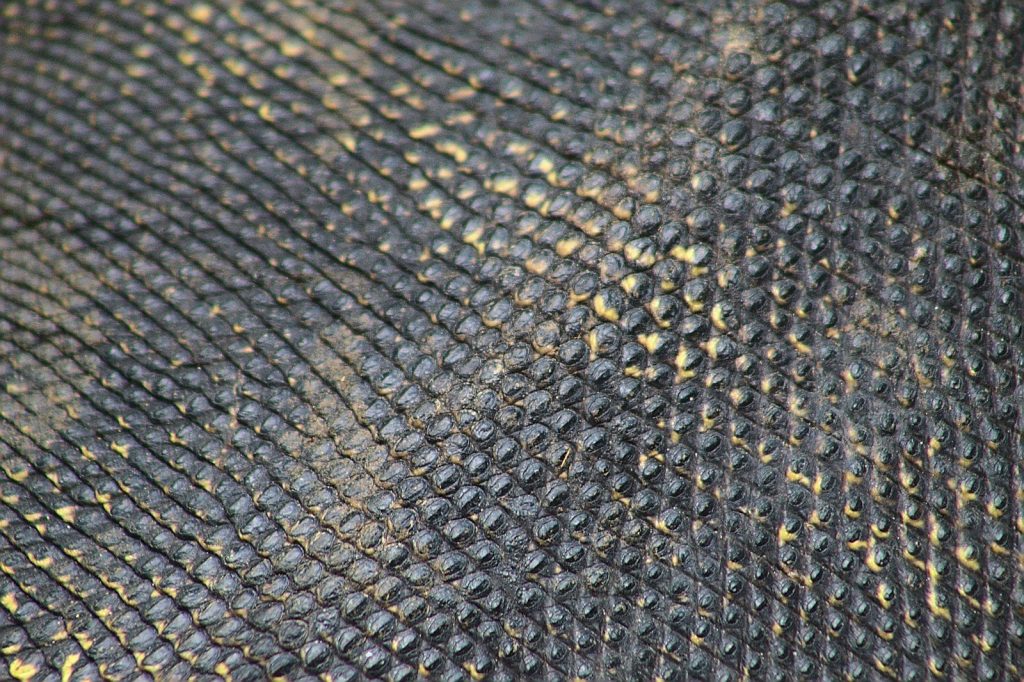
Honest sourcing note: We name every species accurately — saltwater crocodile (Crocodylus porosus), Nile crocodile (C. niloticus), American alligator (Alligator mississippiensis), caiman, reticulated python, monitor/ring lizard, ostrich and stingray — and never sell embossed calf as “exotic”. Most exotic leather is CITES-regulated (commonly Appendix II); legal cross-border trade needs export/import permits and source codes, and buyers are responsible for their country’s rules — this is general information, not legal advice; verify with your CITES Management Authority and customs broker. Prices, MOQ and lead times are indicative ranges (2025–2026), by quote. Luxury houses are referenced only as neutral examples — no affiliation. We are a B2B sourcing desk, not a tannery: we coordinate vetted, CITES-compliant suppliers.
Reticulated python skin guide means understanding the exact species, grades, lengths, pricing logic and CITES paperwork behind this workhorse exotic. This page walks through how reticulated python (Python reticulatus) is tanned, sized, graded and traded from Indonesian tanneries to your workshop, with indicative wholesale ranges and realistic MOQs.
What is reticulated python leather?
Reticulated python leather comes from Python reticulatus, a large, non‑venomous snake native to Southeast Asia and listed on CITES Appendix II. In the leather trade it is usually shortened to “retic” or “retic python”.
Key points for sourcing:
– Species (scientific name): Python reticulatus (never just “generic python” in paperwork)
– Typical origins in trade: Indonesia, Malaysia, sometimes Vietnam and Laos
– CITES status: Appendix II (regulated international trade, not a blanket ban)
– End products: Handbags, SLG (wallets, cardholders), belts, footwear, watch straps, small leather goods, trims
For most luxury and independent ateliers, reticulated python is the volume python article: long skins, relatively predictable pattern, available in a wide range of finishes and grades.
Raw, wet‑blue, crust or finished: which stage should you buy?
In the python trade, you can buy at four main processing stages. Your ideal point depends on whether you are a brand/atelier, a tannery, or a finishing house.
- Raw (salted / dried)
- Untanned, preserved skins direct from the slaughter/collecting point. Lowest cost per metre, but you carry tanning risk, rejects and yield uncertainty. Mostly for tanneries, not brands.
- Wet‑blue
- Chrome‑tanned, wet, blue‑grey in colour. Semi‑finished state used by tanneries/finishers who want to control re‑tanning and finishing. Needs full finishing before cutting.
- Crust
- Fully tanned, dried, usually neutral colour and un‑finished surface. Easier to ship and store than wet‑blue. Bought by finishers and some brands that run their own finishing line.
- Finished
- Ready‑to‑cut leather in the agreed colour, sheen and touch. This is what most brands, ateliers and ODM factories buy: predictable, inspected, and directly usable in production.
Exotic Leather Wholesale operates as a sourcing desk, not a tannery. We match your specification to Indonesian tanneries that can supply raw, crust or finished reticulated python, but most B2B buyers we handle request finished skins for production and small lots of crust for sampling.
If you need help deciding which processing stage fits your project, you can plan your trip through the sourcing process with us on email or WhatsApp — from spec to sample to shipment.
Python skin lengths, widths and measurement methods
Python skins are not sold by square foot like bovine leather. They’re priced by length (sometimes with a width band) or by piece.
For reticulated python, standard trade practice is:
– Measurement line: Along the centre of the belly, from head cut to tail tip
– Unit: Centimetres (cm) or inches; invoices often in cm
– Billing: Per cm within a size band, or per skin within length classes
Typical finished reticulated python skin lengths from Indonesian tanneries:
– Short: 200–240 cm
– Standard: 240–280 cm
– Long: 280–320+ cm
Usable cutting area depends on your product:
– Belts: Focus on continuous straight length and belly width
– Bags/panels: Focus on maximum rectangular area at the mid‑section
– Small leather goods/watch straps: Shorter skins often sufficient; pattern alignment matters more than raw length
Python skin grades: how retic is actually graded in trade
Python skin grades vary by tannery, but most Indonesian reticulated python exporters use a commercial grading system roughly aligned with export requirements and luxury expectations.
You’ll often see:
– Grade I / 1st grade
– Clean belly and flanks
– Minimal natural defects, no major holes
– Consistent colour and finish
– Suitable for visible bag panels and high‑end belts
– Grade II / 2nd grade
– Some small defects or natural scars
– Minor unevenness in colour or sheen
– Good for less visible panels, medium‑end products, or brands accepting some natural character
– Grade III and below / “B” grades, industrial
– Visible defects, holes, repairs
– Often used for small panels, accessories, or heavily finished/washed styles
– Very price‑sensitive
Crucially, python grading considers:
1. Pattern and symmetry – how regular the natural pattern looks across the belly and flanks
2. Mechanical damage – holes, cuts, flay marks from skinning
3. Tanning/finishing defects – uneven dyeing, cracking, poor adhesion of finish
4. Size class – a “Grade I” in a short size band is not equivalent in value to the same grade in a long band
Ask your supplier to define in writing what Grade I/II means in their plant. For B2B work, we often share reference photos and reject tolerances (e.g. “one repair allowed per skin, no belly holes”).
Key facts: reticulated python sourcing at a glance
| Parameter | Typical options / ranges | Notes (Indonesia–EU trade focus) |
|---|---|---|
| Species | Python reticulatus | CITES Appendix II; must be labelled correctly on docs and invoices. |
| Processing stages | Raw, wet‑blue, crust, finished | Most brands buy finished; crust sometimes for in‑house finishing labs. |
| Typical finished lengths | 200–320+ cm | Measured along belly; billed per cm or per size band. |
| Common grades | I (A), II (B), III+ | Defined per tannery; Grade I suited to visible panels for luxury‑level goods. |
| Core finishes | Natural, semi‑aniline, full aniline, glazed, matte, nubuck, metallic, printed | Special effects (pearlescent, foil, hand‑wipe) add cost and lead time. |
| Indicative MOQs (finished) | 20–50 skins per colour/finish | Lower for stock colours, higher for custom colour/finish combos. |
| Lead times (finished) | 4–10 weeks ex‑tannery | Depends on colour development, finishing complexity, and CITES permitting. |
| Price drivers | Length, grade, finish, volume, documentation | Longer, cleaner skins in complex finishes price at the top of the range. |
| CITES source codes | W, R, F, C, D | Most reticulated python in Indonesia is wild‑sourced (W) or ranched (R). |
All MOQs, lead times and pricing mentioned below are indicative ranges last verified June 2026 and should be confirmed by quote.
How Indonesian reticulated python compares to Europe and elsewhere
Most European tanneries working in python import raw or crust from Indonesia and finish it in France or Italy. That has implications for cost structure and control.
Indonesia (Java and beyond)
– Strengths
– Direct access to raw material and quota
– Competitive labour and energy costs
– Ability to run large volumes in standard finishes
– Good match for commercial‑grade, high‑volume requirements
– Considerations
– Finish consistency can vary between plants
– Colour development and lab‑to‑bulk control must be managed tightly
– Logistics and export paperwork need a competent partner
France / Italy
– Strengths
– Advanced finishing, including ultra‑uniform metallics and very specific luxury house standards
– Proximity to many European brands and OEM factories
– Strong colour labs and trend‑driven article development
– Considerations
– Higher per‑skin cost (labour, overheads, compliance)
– Often rely on Indonesian raw/crust anyway
– Some limitation on length availability versus direct Indonesian sourcing
Singapore / trading hubs
– Role
– Trading, consolidation, re‑export, sometimes financial structuring
– Limited tanning capacity; more a logistics and distribution point
For many B2B buyers, the smart approach is:
– Use Indonesian finished python for commercial colours and price‑sensitive collections
– Reserve EU‑finished python for flagship SKUs where ultra‑tight colour control or specific house references are mandatory
Our job as a sourcing desk is to map your brief to the right plant and finish line, not to push one region over another.
Finishes and articles: what you can realistically order
Reticulated python can take almost any finish you see in luxury retail, but not all plants execute all processes equally well. Common, reliable options from Indonesian tanneries include:
Classic belly and back‑cut articles
– Belly‑cut:
– Belly centred, symmetrical diamond pattern on the flanks
– Favoured for bags, belts, and SLG panels
– Usually higher‑priced due to better yield and appearance
– Back‑cut:
– Dorsal pattern centred; belly on the sides
– Used for special pattern‑driven looks and sometimes for straps
Specify clearly which cut you need; it affects both pattern layout and pricing.
Surface finishes
– Natural / aniline:
– Transparent dyes showing full natural pattern
– Soft hand, higher rejection risk; best for high grades
– Semi‑aniline:
– Light pigment overlay to mask small defects but keep pattern visible
– Good balance of yield and aesthetics
– Full pigment / opaque colours:
– Strong coverage; hides many natural defects
– Pattern can be re‑emphasised with emboss or print
– Glazed high‑shine:
– Mechanical glazing for mirror‑like finish
– Popular for belts and formal SLG
– Matte:
– Low gloss, “dry” look, often waxed
– Favoured by brands wanting a modern, understated exotic
– Nubuck / lightly buffed:
– Soft, suede‑like touch
– Requires high‑grade crust; more delicate in use
– Metallic, pearl, foil, hand‑wipe:
– High fashion looks; more expensive and longer lead times
– Require strict QC to avoid cracking or delamination at bends
Thickness
Most reticulated python from Indonesian tanneries is split and finished around:
– 0.4–0.6 mm: Watch straps, very fine SLG
– 0.6–0.8 mm: Standard wallets, cardholders, bag panels with backing
– 0.8–1.0 mm: Belts (with reinforcement), more structured goods
Discuss final product construction so the tannery can target the right thickness and temper.
Indicative wholesale price ranges (2025–2026)
Exact pricing for reticulated python is always by quote, but buyers still need ballpark ranges for planning.
Indicative ranges for finished reticulated python skins exported from Indonesia, last verified June 2026:
– Commercial grades, standard colours, standard lengths (approx. 240–280 cm):
– Roughly equivalent to low–mid double‑digit USD per skin in volume orders
– Grade II cheaper; Grade I at the top of this band
– Premium grades, long lengths (280–320+ cm), complex finishes (metallic/pearl/hand‑wipe):
– Can move into mid–high double‑digit USD per skin
– Extra for highly customised colour development, very tight colour tolerances, or special effects
Key price drivers you should discuss at RFQ stage:
1. Length band (e.g. 220–240, 240–260, 260–280, 280+ cm)
2. Grade mix (100% Grade I, or I/II blend, or commercial mix)
3. Finish complexity (simple aniline vs. multi‑stage metallic + hand finishing)
4. Order size (one‑off 20‑skin test vs. repeat 200–500 skin call‑off)
5. Documentation and logistics (CITES, packing, consolidation, forwarder choice)
For crust or wet‑blue, expect a discount versus finished skins, but factor in your own finishing, loss and reject costs.
MOQs and lead times: how to plan production
Reticulated python is still an exotic article; tanneries must plan runs carefully. MOQs are driven by drum size, colour lab work, and finishing line set‑up.
Typical ranges we see from Indonesian suppliers:
– Stock colours / standard articles
– MOQ: as low as 10–20 skins if pulled from existing stock
– Lead time: 1–3 weeks for picking, QC, CITES export permit, and shipment (subject to permit issuance)
– Custom colours, standard finishes
– MOQ: 20–50 skins per colour
– Lead time: 4–8 weeks ex‑tannery after lab dip approval, plus CITES permit time
– Custom colours with complex finishes (metallic, pearl, hand‑wipe, special emboss)
– MOQ: typically 50+ skins per colour/finish combo
– Lead time: 6–10 weeks ex‑tannery
CITES export permits introduce an additional timing layer. In Indonesia, allow:
– 1–3 weeks for permit processing after final packing list and invoice, depending on authority workload and completeness of documentation.
Production planning rule of thumb for first runs:
– Back‑calculate from your factory start date
– Add: tannery production + internal QC + CITES export permit + shipping + import/customs + inbound QC
– This often totals 8–14 weeks door‑to‑door for custom colours
For brands or OEMs coordinating multiple exotics and bovine articles, we can help sequence shipments and documentation — just plan your trip with us by email or WhatsApp so timelines are realistic.
CITES and compliance: what you must get right
Reticulated python (Python reticulatus) is on CITES Appendix II. That means:
– International commercial trade is allowed, but regulated
– You need the correct CITES export permit from the origin country
– Many import countries also require import permits or other wildlife documentation
Core CITES points for B2B buyers:
– Species name must appear correctly on permits and invoices: *Python reticulatus*
– Source code describes origin:
– W – Wild
– R – Ranched
– C/F/D – Various forms of captive breeding/farming (less common in retics than in some other reptiles)
– Purpose code is usually “T” for commercial trade
This information is for general guidance only and is not legal advice. Requirements differ by jurisdiction (e.g. EU, UK, US, Japan, GCC). Always check with:
– Your national CITES Management Authority
– Your customs broker or compliance team
As a sourcing desk, we coordinate with Indonesian exporters who are used to issuing CITES documents and aligning them with commercial paperwork. You remain responsible for your own import compliance, but we can help flag typical documentation and packing‑list requirements.
Who buys reticulated python and for what products?
Reticulated python is one of the more widely used exotics across:
– Luxury and premium brands in Europe, US and Asia (bags, belts, SLG, footwear)
– Independent ateliers and makers producing limited runs and bespoke projects
– OEM/ODM factories in Asia building collections for multiple labels
– Watch and jewellery strap makers supplying to brands and independent horologists
– Interior and automotive trim specialists (small‑area accents, not large panels)
Use‑case patterns:
– High‑end handbags & SLG
– Typically Grade I or I/II mix
– Matte, semi‑aniline, or special metallic finishes
– Demands very tight colour matching and consistent pattern across panels
– Belts and straps
– Priority on length and straightness
– Glazed or semi‑glazed finishes common
– Often buy matched length and width bands
– Fashion footwear
– Can absorb Grade II in clever pattern placement
– Uses both belly‑ and back‑cut articles
– Appreciates unique patterns, even with some natural irregularities
Understanding your final product range allows us to calibrate grade mix and finish. For example, a brand launching a single hero bag style might specify “100% Grade I, 280+ cm”, while a footwear factory may accept “commercial mix, 220–260 cm” to manage cost.
How Exotic Leather Wholesale fits into your python sourcing
Exotic Leather Wholesale is a B2B sourcing desk for CITES‑compliant exotic leather, with a strong focus on Indonesian supply — including reticulated python.
What we do in this category:
– Translate your spec into tannery language
– Species (Python reticulatus)
– Length bands and grades
– Thickness, temper, colour, finish
– Target price and volume
– Match you with suitable Indonesian tanneries
– Evaluate who can hit your requirements at the right level (commercial vs. luxury)
– Balance price, quality and lead time
– Coordinate sampling and approvals
– Swatch books, lab dips, and pre‑production skins
– Feedback loop with finishing lab
– Support documentation and logistics
– Ensuring packing lists and invoices align with CITES permits
– Coordinating with your nominated forwarder or suggesting options
No one can pay to change what we publish; if you proceed with our partner they may pay us a referral fee at no extra cost to you.
To start a project or request indicative ranges for your python brief, you can plan your trip with us — we typically move initial scoping via email and WhatsApp so specifications are clear before we approach partner tanneries.
FAQs: Reticulated python skin sourcing
How are reticulated python skins measured and priced?
They are measured along the belly from head cut to tail tip, usually in centimetres. Pricing is typically per cm within a length band or per skin by size class, with longer, cleaner skins commanding higher prices. Trade quotes will specify length bands, grades and finish.
What grades of reticulated python are suitable for luxury handbags?
Most luxury‑positioned handbags use Grade I or a tight I/II mix, with minimal visible defects on the belly and flanks and very consistent colour. Lower grades can be used for less visible panels or smaller goods, but for front panels brands usually insist on Grade I.
Can I order very small quantities of custom‑coloured python?
True custom colours usually start around 20–50 skins per colour per finish, because tanneries must set up drums and finishing lines. For very small runs, it is often more economical to select from existing stock colours or to tweak a near‑stock shade.
Is reticulated python legal to import into the EU or US?
Reticulated python (Python reticulatus) is CITES Appendix II, so international commercial trade is allowed with the correct CITES export permit and any required import documentation. Rules vary by country and can change, so you must verify requirements with your national CITES authority and customs broker; this page is general information, not legal advice.
What lead time should I plan for a first order from Indonesia?
For a new colour and finish, a realistic planning window is 8–14 weeks door‑to‑door, including lab dips, production, internal QC, CITES export permit, shipping and customs. Repeat orders on the same article can be faster once colour and specs are frozen.