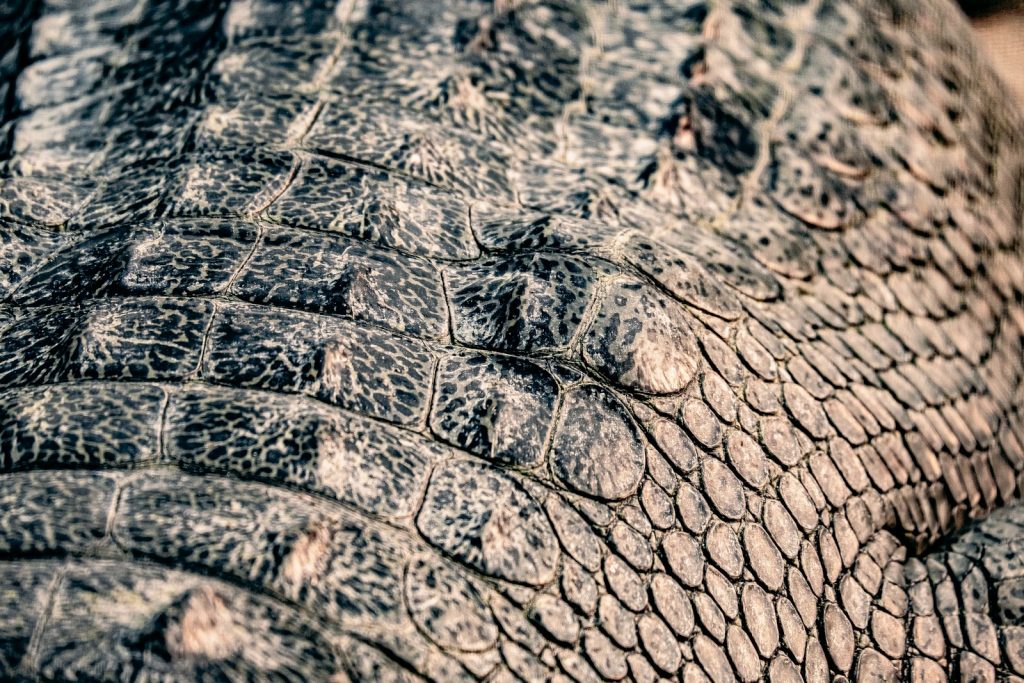
Honest sourcing note: We name every species accurately — saltwater crocodile (Crocodylus porosus), Nile crocodile (C. niloticus), American alligator (Alligator mississippiensis), caiman, reticulated python, monitor/ring lizard, ostrich and stingray — and never sell embossed calf as “exotic”. Most exotic leather is CITES-regulated (commonly Appendix II); legal cross-border trade needs export/import permits and source codes, and buyers are responsible for their country’s rules — this is general information, not legal advice; verify with your CITES Management Authority and customs broker. Prices, MOQ and lead times are indicative ranges (2025–2026), by quote. Luxury houses are referenced only as neutral examples — no affiliation. We are a B2B sourcing desk, not a tannery: we coordinate vetted, CITES-compliant suppliers.
Real vs fake exotic leather is first a question of species and structure, not branding or price. If you know how genuine crocodile, python, lizard or stingray skin is built, you can separate real exotic from embossing in seconds.
As Lead Editor for Exotic Leather Wholesale, I want to strip out the myths and marketing tricks and give you a trade-level framework you can actually use at the bench and at the buying desk.
—
What “Real Exotic Leather” Actually Means
Before we talk about a genuine exotic skin test or embossed vs real exotic, we need precise definitions.
- Real exotic leather = tanned skin from a specific exotic species (e.g. Crocodylus porosus), declared correctly by species, origin and, if international trade is involved, backed by correct CITES paperwork where required.
- Fake exotic leather can mean:
- Embossed bovine/goat/sheep made to look “croc” or “python”.
- PU/PVC or other synthetics printed and embossed with an exotic pattern.
- Mislabelled skins (e.g. caiman sold as “porosus”, goat sold as “lizard”).
Real exotic leather is about traceable biology and lawful trade, not just a scale pattern.
—
Core Principles: Real vs Fake Exotic Leather
Here is the short version professionals use at the inspection table.
| Check | Real Exotic Leather | Embossed / Fake Exotic |
|---|---|---|
| Species structure | Natural irregularity; each scale/osteoderm unique | Repeating pattern tile; perfect symmetry |
| Pore / follicle pattern | Consistent with species (e.g. python pits, lizard pores) | Printed dots or no pores at all |
| Cross-section | Single skin layer; no woven fabric or foam | Multi-layer: plastic + fabric or coated bovine crust |
| Back side | Suede/flesh side consistent with reptile/fish fibre | Textile backing or split-cow suede with emboss marks |
| Flex & break | Scales move differently along/against spine; fibre drag | Uniform plastic bend; surface “cracks” printed film only |
| Smell (tanned) | Leather smell (chrome/veg/combination), no plastic odour | Plastic/chemical odour on PU/PVC |
| Regulatory | CITES App. I/II where applicable, correct source codes | Usually no species/CITES mention; often generic “leather” |
If a “crocodile” panel shows a perfectly repeating tile and textile backing, it is not genuine crocodilian skin.
—
Species-by-Species: What Real Exotic Looks and Feels Like
Below I focus on the main species we source and grade. Correct identification comes before any genuine exotic skin test.
Crocodile, Alligator, Caiman
Common trade species:
- Crocodylus porosus (saltwater / porosus crocodile) – CITES App. II
- Crocodylus niloticus (Nile crocodile) – CITES App. II populations (check country-specific listings)
- Alligator mississippiensis (American alligator) – CITES App. II
- Caiman crocodilus fuscus and related caiman species – CITES App. II
Real crocodilian clues:
- Osteoderms (bone plates) in back and some flank scales — you feel hard “buttons” under the finish.
- Umbilical scar in the centre belly of crocodile/alligator — a natural star-like mark luxury houses often feature on small leather goods.
- Scale geometry varies from belly (large, rectangular) to flanks (irregular) to tail (higher, harder).
Typical measurement in trade:
- Belly width in cm at the widest point, measured skin laid flat, scale edge to scale edge.
- Length nose-to-tail in cm, not including stretched edges.
Most top-belt/strap work uses 30–36 cm bellies; bags often require 40+ cm.
Python
Common trade species:
- Python reticulatus (reticulated python) – CITES App. II
- Python bivittatus (Burmese python) – CITES App. II
Real python traits:
- No osteoderms; scales are thin and flexible.
- Narrow belly with broad, regular ventral scales; flanks become small overlapping scales.
- Natural colour transitions follow the animal’s pattern; under semi-aniline finishes you see depth, not flat print.
Measurement:
- Length in cm or meters along the spine after tanning.
- Usable width in the centre in cm (after trimming edges).
For small leather goods and shoes, many ateliers work comfortably with 22–30 cm usable width.
Lizard
Common trade species:
- Varanus salvator (water monitor lizard) – CITES App. II
Real lizard indicators:
- Very fine, uniform scales on flanks; belly scales slightly larger but still small vs crocodile.
- Natural tiny pores at scale joints; under magnification you see organic, not printed, structure.
- Belly-cut vs back-cut changes the visible pattern: belly-cut shows the small flank scales as the main surface.
Typical measurement is overall length and central belly width; smaller skins limit panel size to watch straps, wallets and small goods.
Stingray and Other Fish Skins
Common trade species (examples):
- Stingray in several Dasyatidae species (check CITES/local status per origin)
- Fish such as salmon, tilapia, carp — generally non-CITES but must still meet national rules
Real stingray features:
- Bead-like “pearls” of mineralised denticles; very hard surface even after polishing.
- Central crown/eye — a natural denser cluster of pearls on the back.
- Cross-section shows dense, granular top with fibrous leather underneath, not just a plastic bead layer.
Embossed “ray” on bovine often has uniform dots and a much softer fingertip feel.
—
Common Fakes: Embossed vs Real Exotic
Embossed cow, goat or PU has a real role in the market. The problem is only when it is sold as if it were genuine exotic.
How Embossed Bovine is Made to Imitate Exotic
Typical process:
- Start with bovine crust or finished sides.
- Apply pigment/foil/print to build colour pattern.
- Pass under a heated plate or roller engraved with “croc”, “python” or “ray” pattern.
Result: a repeating, shallow texture riding on top of standard bovine fibre.
Spotting Embossed vs Real Exotic in Hand
Use this quick checklist at a showroom or factory visit:
- Pattern repeat: Move 20–30 cm across the panel. If you see identical “scale clusters” repeating like wallpaper, you are looking at an embossing plate, not a reptile.
- Depth and undercut: Real crocodile scales have tiny undercuts and slight lifting edges; embossed cow is shallow, rounded, and consistent.
- Backside:
- Real reptile: thinner, often 0.6–1.0 mm crust before finishing for luxury; flesh side shows fine reptile fibre.
- Embossed cow: thicker (often 1.2–2.0 mm), familiar bovine suede; emboss marks sometimes ghost through.
- Cut edge: On a finished strap or wallet, examine the raw edge under light:
- Real exotic: pattern continues through the thickness of the skin; no separation between “print” and leather.
- Emboss/PU: top film and base often visible as distinct layers.
If you need help validating a supplier sample, our sourcing desk is happy to review photos, measurement specs and CITES details for trade clients — you can plan your trip or book a WhatsApp call to go through it skin-by-skin.
—
Practical Genuine Exotic Skin Tests (Non‑Destructive)
Here are trade-safe checks you can do without destroying an expensive sample.
1. Cross-Section and Edge Inspection
Use a loupe or macro camera:
- Real exotic: fibrous leather structure through the full thickness; surface scales are part of that structure.
- PU/PVC or film: smooth plastic top layer, often 0.1–0.3 mm, sitting over fabric or leather.
On straps, look where the maker has bevelled or skived; fake exotics often reveal a separate top film.
2. Scale Mobility and Orientation
Gently push and bend:
- Crocodilian: belly scales are more flexible; moving towards the tail you feel stiffness. Scales at the spine behave differently from flanks.
- Python: small scales near the flanks flex easily and may slightly lift at edges under reverse bend.
- Embossed bovine: the “scales” do not move independently at all — they are just hills in a uniform sheet.
3. Pore and Mark Pattern
Under magnification:
- Real exotic: pores differ from scale to scale; some scales show minor growth marks, scars or insect bites.
- Printed fake: dots are uniform, aligned, often with visible halftone/screen patterns.
4. Weight and Handle vs Thickness
With experience, you recognise density:
- Real reptile at 0.8 mm feels “crisp” and dense vs bovine split at same thickness, which feels more spongy.
- PU at 1.2 mm with textile backing feels light and springy, with a cool plastic surface.
5. Smell and Heat Response (Cautious Use)
- Smell: Real leather smells like tanned hide (chrome or vegetable). PU often has a synthetic or solvent odour, especially on fresh stock.
- Heat (not recommended on client goods): A very light heated pin on a cut scrap:
- Real leather chars and smells like burnt hair.
- Plastic melts and smells chemical.
For high-value items, keep tests non-destructive and rely on structure, documentation and supplier credibility.
—
CITES, Species Claims and Legal Reality
Any discussion of real vs fake exotic leather must include CITES and honest species naming. This section is general information only, not legal advice — always verify requirements with your national CITES Management Authority and customs.
Key CITES Points for Exotic Leather Buyers
- Many crocodiles, alligators, caimans, some lizards and some rays are listed under CITES Appendix I or II.
- International trade in raw and finished skins for App. II species (e.g. Crocodylus porosus farmed) typically requires:
- CITES export permit from the country of origin; and
- CITES import permit in some jurisdictions.
- CITES documents include source codes such as:
- C – Bred in captivity
- F – Born in captivity (not meeting full “C” definition)
- W – Wild
- D – Appendix I captive-bred for commercial purposes
- R – Ranched (taken from the wild as eggs/juveniles and reared)
A supplier who cannot provide the correct species name and CITES documentation for a regulated species is a risk — even if the skin is biologically “real”, it may not be legally tradable for your project.
Exotic Leather Wholesale operates as a sourcing desk, working with Indonesian tanneries and exporters that supply correctly documented CITES App. II skins. We do not issue CITES permits ourselves; we coordinate the chain so your shipment has the paperwork from the right authorities.
—
Grades, Measurements and How Fakes Often Cheat
Fakes and misrepresentations are not only about species. They also show up in grading and measurement.
Real Grading: I–IV Defect Logic
While grading systems vary slightly by tannery, most follow similar principles:
- Grade I
- Clean main panel (e.g. central belly), minimal or no visible defects, suitable for flagship products.
- Grade II
- Minor natural marks or handling defects in less critical areas; cutting yields premium panels with some careful planning.
- Grade III
- Noticeable marks, scars, holes or uneven dye/finishing impacting usable yield; often good for smaller goods or vintage/distressed looks.
- Grade IV
- Heavy defects, test pieces; used for small components or experimental work.
Common misrepresentations:
- Grade III–IV skins sold in photos as if they were Grade I (cropping out defects).
- Measurements taken along curves or including ragged edges to inflate stated belly width or length.
At our desk, we insist on belly-width measured flat, scale edge to scale edge, and grade based on the usable central panel you can realistically cut for your pattern.
Indicative Wholesale Ranges (By Quote, 2025–2026)
All pricing for exotics is volatile and depends on:
- Species and origin
- Belly width / length
- Grade (I–IV)
- Finish (crust vs finished, aniline vs pigment, special effects)
- Order volume and mix
Based on the Indonesian export context and international demand (last verified June 2026), trade-level wholesale ranges often fall roughly as follows for tanned but unfinished or standard finishes, per skin:
- Farmed crocodile (Crocodylus porosus/niloticus)
- Medium belly widths for belts/wallets: typically higher-end price band per piece.
- Larger bellies suitable for bags and panels: significantly higher price band per piece.
- Caiman (Caiman crocodilus fuscus and relatives)
- Generally lower than true crocodile/alligator for comparable sizes and finishes.
- Python (Python reticulatus, Python bivittatus)
- Standard lengths and widths for fashion: moderate price per skin; wide/long premium pieces can trend higher.
- Lizard (Varanus salvator)
- Smaller skins; per-piece price in the mid exotics range, total spend depends on quantity for paneling.
- Stingray and other fish
- Generally mid to lower exotics price per piece, with premium for clean, large ray “eyes” and consistent dye.
These are directional only. We quote by specification, grade mix, finish and volume, and we flag any shifts (e.g. CITES quota changes, currency). For a project-specific RFQ or sampling plan, plan your trip or request a WhatsApp consultation with our team.
—
Use-Case Matching: Which Species and Grade for Which Product?
Understanding real vs fake exotic leather also means selecting the right genuine species and grade for your finished product, so you don’t overpay or under-spec.
Belts and Straps
- Ideal: Grade I–II Crocodylus porosus/niloticus or Alligator mississippiensis, 30–36 cm belly width, consistent dye.
- Alternatives: Caiman for more price-sensitive lines; python for fashion-forward, non-formal belts.
- Watch straps: Many houses use fine flank panels from Grade I–II crocodile or lizard (Varanus salvator).
Handbags and Small Leather Goods
- High-end bags: Large, clean Grade I porosus or niloticus bellies for front/back panels; Grade II acceptable on less visible areas.
- SLGs (wallets, card holders): Smaller panels allow smart use of Grade II–III skins without compromising visible quality.
- Python bags: Well-matched pattern and colour symmetry across panels is more important than a perfectly defect-free entire skin.
Footwear
- Uppers: Python, lizard and crocodile flanks are common; you can often use Grade II–III, as many natural marks fall outside visible zones.
- Trims: Small components are an excellent way to utilise Grade III–IV skins, reducing waste and cost.
If a supplier proposes a very low price for what they call Grade I large-belly “porosus” suitable for hero bag panels, treat it as a trigger to re-check species, grading and documentation.
—
Working With a Sourcing Desk vs Guessing Alone
A lot of “fake” in this industry is less about pure counterfeit and more about misalignment: species mislabelled, CITES ignored, grades over-promised, measurements inflated.
Exotic Leather Wholesale operates as a B2B sourcing desk:
- We are not the tannery; we work with a vetted network of Indonesian tanneries and exporters.
- We insist on accurate species naming and clear belly width / length measurement on every lot.
- We grade skins ourselves I–IV based on the central usable area and typical luxury cutting needs.
- We coordinate with exporters on CITES-compliant supply for Appendix II species (and guide clients to confirm their own import requirements).
For brands, ateliers and manufacturers, this reduces the risk that “real vs fake exotic leather” becomes an expensive learning curve.
To discuss a live collection brief, receive indicative ranges, or schedule tannery visits in Indonesia, you can plan your trip and we’ll follow up via email or WhatsApp to structure a sourcing plan.
—
FAQs: Real vs Fake Exotic Leather
How can I quickly tell real crocodile from embossed cow leather?
Check for natural irregularity and depth of scales, feel for hard osteoderms under back and tail scales, and inspect the cut edge. Real crocodile has bone plates and a continuous leather structure; embossed cow shows a shallow, repeating pattern and a uniform bovine fibre cross-section. The backside of an embossed cow panel usually looks like standard cow suede, not the thinner reptile flesh side.
Is python leather always CITES-regulated?
Most commercially used python species, including Python reticulatus and Python bivittatus, are listed in CITES Appendix II, so international trade typically requires CITES export permits and, in some countries, corresponding import permits. This is general information, not legal advice — always confirm requirements with your national CITES authority before importing or exporting python products.
Can I rely on a “genuine leather” label for exotic products?
No. “Genuine leather” only confirms that the material is animal hide rather than synthetic; it does not identify the species. A cow leather embossed with a crocodile pattern can still legally be called “genuine leather” in many jurisdictions. For exotic work you need the specific species name, origin, and, for CITES-listed species, the supporting permits.
Are Grade III–IV exotic skins useless for luxury products?
Not at all. Grade III–IV skins have more visible defects across the whole surface, but you can often cut clean areas for small components, interior parts, or intentionally distressed/vintage aesthetics. Many high-end brands quietly use lower grades in non-visible positions while reserving Grade I–II for key panels.
Can Exotic Leather Wholesale certify CITES compliance for my shipment?
We coordinate with tanneries and licensed exporters so that CITES-listed skins we help source are backed by the appropriate export permits from the relevant authority. However, we do not issue CITES documents ourselves, and we cannot provide legal advice. You remain responsible for securing any import permits and for verifying current regulations with your own CITES Management Authority.