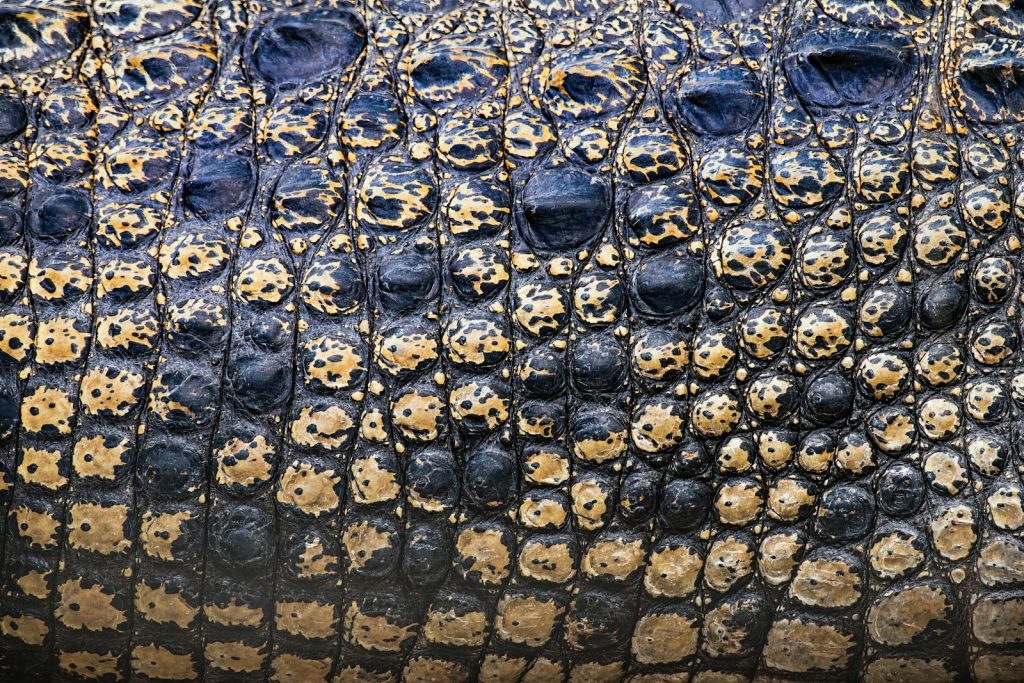
Honest sourcing note: We name every species accurately — saltwater crocodile (Crocodylus porosus), Nile crocodile (C. niloticus), American alligator (Alligator mississippiensis), caiman, reticulated python, monitor/ring lizard, ostrich and stingray — and never sell embossed calf as “exotic”. Most exotic leather is CITES-regulated (commonly Appendix II); legal cross-border trade needs export/import permits and source codes, and buyers are responsible for their country’s rules — this is general information, not legal advice; verify with your CITES Management Authority and customs broker. Prices, MOQ and lead times are indicative ranges (2025–2026), by quote. Luxury houses are referenced only as neutral examples — no affiliation. We are a B2B sourcing desk, not a tannery: we coordinate vetted, CITES-compliant suppliers.
Porosus vs niloticus crocodile skin is, in practice, a question of species, scale pattern, grading and price–performance for your product range. “Saltwater vs Nile crocodile leather” are trade shortcuts; the real decision is which of these two CITES-listed species, properly measured and graded, fits your design and margin targets.
Porosus vs Niloticus: Definition-First
Porosus in trade refers to Crocodylus porosus, the saltwater crocodile originally native to coastal and estuarine areas from India through Southeast Asia to Northern Australia. In leather, it is the benchmark “top-of-the-pyramid” crocodile for high-end watch straps, small leather goods and handbags.
Niloticus refers to Crocodylus niloticus, the Nile crocodile from sub-Saharan Africa and some island populations. In the trade it is sometimes called “Nile croc” or just “Nile”. Compared with porosus, it is more available, usually slightly larger per skin, and typically priced below porosus at the same grade.
Both are real crocodile skins (Family Crocodylidae), not caiman and not embossed calf. Both are listed on CITES Appendix II in regulated farming and ranching programs in producing countries. The differences that matter for B2B buyers are:
- Scale shape and symmetry
- Belly width and length distribution
- Typical defect pattern and grading yield
- Price per cm vs finished product retail positioning
Below I’ll break down porosus or niloticus choice the same way we do at Exotic Leather Wholesale when we source from Indonesian tanneries for clients’ ateliers.
Species, CITES Status and Trade Reality
Accurate species naming
For B2B, “crocodile” is not precise enough. Your documentation, product specs and internal costing should specify:
- Crocodylus porosus – saltwater crocodile, often abbreviated “porosus”.
- Crocodylus niloticus – Nile crocodile, abbreviated “niloticus”.
Anything described as “croc-embossed”, “croc print” or “Italian crocodile” without a species name is almost always bovine or goat with embossed pattern. Caiman (Caiman crocodilus or others) is also sometimes sold loosely as “crocodile”; it is a different animal with different scale structure and mechanical behavior.
CITES and legality (general information only)
Both porosus and niloticus skins in international trade move under CITES Appendix II controls from approved farming, ranching and wild harvest programs. Typical CITES source codes you’ll see on permits:
- C – Bred in captivity
- F – Born in captivity (not meeting full definition of bred in captivity)
- R – Ranched from wild eggs or juveniles
- W – Wild-sourced
Laws differ by jurisdiction and change over time. The summary here is general information, not legal advice. Always verify current requirements with your national CITES Management Authority or a specialized customs broker before shipping or importing porosus or niloticus crocodile skin or finished goods.
Exotic Leather Wholesale is a sourcing desk, not a tannery. We work with Indonesian tanneries that handle tanning and finishing; we coordinate CITES paperwork upstream and logistics downstream so that you can focus on design and production.
Porosus vs Niloticus: Key Technical Differences
This table summarizes the main technical points buyers ask about saltwater vs Nile crocodile leather:
| Aspect | Porosus (C. porosus) | Niloticus (C. niloticus) |
|---|---|---|
| Common trade name | Saltwater crocodile | Nile crocodile |
| Typical farming regions | Indonesia, Papua New Guinea, Australia, SE Asia | Africa, some island programs; crust and finished skins available via Asia/Europe |
| CITES listing | Appendix II (farmed/ranch programs) | Appendix II (farmed/ranch programs) |
| Belly scale shape | Smaller, more rectangular, fine and even | Slightly larger, more squarish/rounded, less uniform |
| Flank/side pattern | Relatively fine, elegant transitions | More prominent relief; stronger “croc” look |
| Average commercial belly width (cm) | 30–48+ cm | 34–55+ cm |
| Typical use focus | High-end small goods, watch straps, compact bags | Mid- to high-end bags, belts, larger panels |
| Price level (Grade I, same finish) | Higher | Lower than porosus at same size/grade |
| Mechanical behavior | Fine grain, good for precise small pattern cutting | Slightly thicker on average, more generous cutting for larger pieces |
| Brand positioning | Top-tier exotic, used by major luxury houses | Recognized exotic, often used where larger panels needed |
How We Measure Crocodile Skins: Belly Width and Usable Length
Marketing descriptions mean little without real measurements. We always work with bona fide belly width in centimeters, not “size class” alone.
Belly width (the primary size index)
Standard practice for both porosus and niloticus crocodile skin:
- Laid flat, flesh side down, belly up.
- Measurement taken across the widest part of the belly, typically near the midpoint between front legs and hind legs.
- Width recorded in centimeters, e.g., 32 cm, 38 cm, 44 cm, etc.
This belly width drives your cutting possibilities:
- 30–34 cm: watch straps, card holders, small wallets, trim.
- 35–39 cm: wallets, clutches, micro/mini bags, small accessories.
- 40–45 cm: mid-size handbags, small crossbody bags, belts (in combination with tail).
- 46–52+ cm: full handbags, larger totes, bigger panels, footwear vamps and quarters.
Usable length and pattern orientation
Besides width, you must think in terms of usable pattern area along the length:
- Central belly (from just behind the throat to before the cloaca) is the prime area for symmetric panels.
- Tail is often used for belts or narrow straps, especially on niloticus where larger overall size is common.
- Flanks are used for smaller components or secondary panels where slight asymmetry is acceptable.
Back-cut vs belly-cut matters for how you place patterns:
- Back-cut crocodile: Cut is made along the back so the belly remains intact and is the main display area. This is the standard for most porosus and niloticus skins used in luxury leather goods.
- Belly-cut crocodile: Cut is made along the belly, exposing the back scales. Used for specific aesthetic where the more rugged back scales are desired (e.g., certain belts or boots). Less common for formal handbags.
At Exotic Leather Wholesale we typically source back-cut porosus and niloticus for leather goods. If you have a project that genuinely calls for belly-cut (back-scale) surfaces, that must be specified clearly in the RFQ.
Grading Crocodile Skins: Grade I–IV and Typical Defects
For both porosus and niloticus crocodile skins, most tanneries in our network work with a Grade I–IV system on the belly. Always confirm the grading standard with your supplier; below is the approach we use and see most often in Indonesian and regional trade.
Grade I (1)
Definition: Essentially clean on the central belly area.
- No major holes, deep scratches, or scars in the central 1st quality panel.
- Minor defects allowed only toward edges or extremities that do not affect a standard handbag panel.
Best for: High-end handbags, wallets, and showcase small leather goods where the belly is the hero panel.
Grade II (2)
Definition: One or more moderate defects on or nearing the central belly, but still plenty of clean cutting area.
- Defects may include small scars, healed marks, or minor holes that can be worked around with smart pattern placement.
- Overall surface still attractive, but not as pristine as Grade I.
Best for: Mid-to-high-end products, bags with clever cutting strategies, smaller goods cut away from defect zones.
Grade III (3)
Definition: Noticeable defects affecting the central belly.
- Larger scars or clusters of defects.
- Useful area on belly reduced; flanks and tail may still yield good smaller components.
Best for: Smaller goods, panels where full symmetry is not required, experimental or entry-level exotic lines.
Grade IV (4)
Definition: Heavy defect presence; utilitarian or decorative use.
- Multiple scars, deep marks, or holes across belly.
- Still real porosus or niloticus crocodile, but suitable mainly for small parts, patches, or craft projects.
Best for: Small leather goods with heavy design intervention (quilting, overlays), accessories where visible imperfections are acceptable or design-intentional.
Porosus generally commands a stronger premium from Grade I to III because yield of perfect bellies is lower and demand for top grades is high. Niloticus can be more forgiving on pricing for Grade II–III bellies, especially in larger sizes.
Price Ranges: Porosus vs Niloticus (Indicative Only)
All prices below are indicative wholesale ranges for crust or finished crocodile skins, last verified June 2026, and always subject to confirmation by quote. Actual offers depend on:
- Size mix (belly width distribution)
- Grade spread (I–IV ratio)
- Finishing (crust vs fully finished, aniline vs semi-aniline, special finishes)
- CITES source codes and origin
- Order volume and regularity
- Porosus, Grade I, 30–39 cm
- Typically in the higher price tier per skin; priced above niloticus for same belly width and finish. Suitable for top-tier watch straps and small goods.
- Porosus, Grade I, 40–48+ cm
- Premium bracket aimed at luxury handbags and big-brand suppliers. Expect a significant step up over smaller sizes and lower grades.
- Porosus, Grade II–III, mixed sizes
- More accessible than Grade I but still priced as a high-value exotic. Attractive where the marketing value of “porosus” justifies the material input.
- Niloticus, Grade I, 34–42 cm
- Generally lower per-skin cost than porosus at similar width, offering a cost-effective route to real crocodile for small-to-medium goods.
- Niloticus, Grade I, 43–52+ cm
- Often the sweet spot for full handbags and belts; price per cm is competitive relative to porosus, with more generous cutting area.
- Niloticus, Grade II–III, mixed sizes
- Workhorse range for brands wanting real crocodile texture at more accessible pricing; ideal for mid-range exotics or where design can hide defects.
Because of platform policies and market volatility we are not publishing fixed numbers here. For a current quote tailored to your size, grade and finish requirements, please plan your trip through the sourcing process with us — we can also coordinate via WhatsApp to make sampling and specification alignment faster.
Which Species Fits Which Product?
High-end small leather goods and watch straps
If your main SKUs are:
- Watch straps (especially for high-end mechanical watches)
- Compact wallets and card holders
- Small clutches or mini-bags with strict symmetry
Porosus Grade I–II in the 30–36 cm range is often preferred because of:
- Finer, more regular belly scales appreciated by detail-oriented clients.
- History of use by top luxury houses, making it easy for your sales team to position.
That said, Niloticus Grade I in similar widths can serve very well where budget is a higher priority and your market is less species-sensitive, especially if you design around slightly larger scales.
Handbags and larger panels
For handbags, things get more nuanced:
- Porosus works beautifully for smaller structured bags and where the “porosus” label itself carries marketing value.
- Niloticus is advantageous if:
- You need larger panels (e.g., 45–50+ cm bellies) for unbroken front and back.
- You plan a line of larger totes or shoulder bags.
- You are targeting a price point below the top tier but want real crocodile, not caiman.
If your collection includes several bag sizes, a mixed strategy is common: porosus for hero pieces and niloticus for volume models.
Belts and long straps
Belts are more about length and segment continuity than absolute belly width:
- Niloticus often yields more efficient belt cutting thanks to slightly larger carcass size on average.
- Porosus is used for belts at the very high end, where species naming is a selling point and ordering volumes are lower.
For many brands, niloticus Grade II–III provides an excellent balance of authenticity and cost in belt programs.
Footwear and specialty items
- Footwear vamps/quarters: Both species can work; niloticus may be easier for larger sizes and more generous pattern pieces.
- Hard-case goods or trunk details: Species choice depends mainly on the visual texture you want and the price point of the piece.
Finish Options: The Species Behave Slightly Differently
Both porosus and niloticus can be supplied as crust or in various finished states:
- Crust: Tanned but not fully finished; suitable if you have finishing capacity in-house or at a partner tannery.
- Classic glazed: High-gloss finish popular in traditional exotic lines.
- Matt / semi-matt: Contemporary aesthetic, often preferred for understated luxury bags.
- Special finishes: Nubuck-like touches, metallics, two-tone effects (subject to feasibility per tannery).
Porosus’ finer scale can give a very sophisticated look in both matt and glazed. Niloticus’ slightly stronger pattern sometimes reads “more crocodile” in matt finishes, which some markets prefer. From a technical standpoint, both species tan and finish well in experienced hands; the more important variable is the tannery’s process control rather than the species itself.
MOQ, Lead Times and Sourcing Logic
As a sourcing desk, our role is to match your product plan with realistic supply chains in Indonesia and the region.
MOQ (minimum order quantity)
Typical realities we see across partner tanneries:
- Porosus: Higher MOQs per color/finish are common, especially for custom colors. For standard black/brown, mixed-size lots can sometimes be smaller.
- Niloticus: Often more flexible on MOQs, particularly where tanneries run regular production for popular colors and finishes.
As a rule of thumb, pilot orders and sample batches are easier to arrange in niloticus for brands testing an exotic capsule, while porosus is usually better reserved for confirmed programs and signature pieces.
Lead times
Lead times are highly project-dependent, but the main drivers are:
- Using existing crust or finished stock vs. making to order.
- Number of colors and finishes you request.
- Seasonal congestion at tanneries and in shipping lanes.
For planning purposes for 2025–2026, allow for a range from several weeks to a few months from confirmed PO and deposit to FOB release, particularly when CITES permitting is involved. For a realistic timeline for your project, please plan your trip through the sourcing and permitting steps with us; WhatsApp coordination often shortens the back-and-forth on specs and documentation.
Honest Comparison: Porosus or Niloticus for Your Brand?
You can think of porosus vs niloticus crocodile skin choice as a matrix of four key axes:
- Target customer and brand story
- If your brand narrative leans heavily on “the very top tier of exotics”, porosus aligns with that message.
- If your story is “authentic exotic, intelligently priced”, niloticus fits neatly.
- Product category mix
- Small goods-heavy: porosus makes sense, with some niloticus for volume SKUs.
- Bag- and belt-heavy: niloticus is often the backbone, with porosus for hero SKUs.
- Price architecture
- Porosus supports high retail price points but raises your material cost base.
- Niloticus gives more room in margin structure for the same retail or allows a lower retail for similar margin.
- Operational constraints
- If you have limited storage and need smaller, more frequent call-offs, we can often build that around niloticus first.
- If you are consolidating a seasonal buy for multiple regions, mixing species by SKU can optimize both cost and supply security.
There is no single correct answer to “porosus or niloticus”. The best decision is always grounded in your bill of materials, expected yields per size/grade, and your retail strategy.
How Exotic Leather Wholesale Can Help
Based in Indonesia, Exotic Leather Wholesale is not a tannery; we are an independent sourcing desk that works across multiple tanneries with established porosus and niloticus programs. That allows us to:
- Specify species-correct, CITES-compliant crocodile skins for your needs.
- Negotiate realistic MOQs and delivery schedules across several facilities.
- Pre-screen lots by grade, measurement and defect patterns, not just marketing labels.
- Coordinate end-to-end: from Indonesian tanneries’ loading bay, through export and CITES, to your nominated freight forwarder or destination airport.
No one can pay to change what we publish; if you proceed with a partner we introduce, they may pay us a referral fee at no extra cost to you. Our job on the sourcing side is to be transparent about species, grades, measurements and indicative pricing so your design and finance teams can make informed decisions.
If you are evaluating porosus vs niloticus crocodile skin for an upcoming collection, share your tech packs or sketches and we can translate them into size/grade mixes and a sourcing plan. Start a sourcing enquiry or RFQ via our plan your trip page — we are happy to continue the specification work over WhatsApp to keep things efficient across time zones.
FAQs on Porosus vs Niloticus Crocodile Skin
Is porosus always better than niloticus?
No. Porosus is generally rarer and more expensive, with a finer scale pattern, which suits certain high-end applications. Niloticus offers slightly larger skins and a strong crocodile look at a more accessible cost. “Better” depends on product, target price and brand story, not on species alone.
Can I mix porosus and niloticus in the same product line?
Yes. Many brands use porosus for hero or flagship items and niloticus for volume SKUs where larger panels or sharper price points are needed. The key is to be transparent in internal documentation and, if relevant to your market, in consumer-facing information about which species is used in which SKU.
Is niloticus crocodile leather less durable than porosus?
Under proper tanning and finishing, both porosus and niloticus are mechanically strong and suitable for long-term use in leather goods. Durability differences in practice are more about tannery quality, finish, and product construction than about the species.
Do I need different CITES permits for porosus and niloticus?
Yes, CITES permits and any additional national documents are species-specific and must match the actual material (including scientific name and source code). Both porosus and niloticus are traded under Appendix II in regulated programs, but exact permit procedures vary by exporter and importer country. Always confirm current requirements with your CITES Management Authority or a specialized broker.
What minimum order quantity should I plan for my first crocodile project?
MOQs vary by tannery, finish and color. As a ballpark, niloticus projects usually allow smaller initial orders than porosus, especially if you work with standard colors. For a realistic MOQ aligned with your design and budget, share your initial spec via our plan your trip page and we can propose a phased approach and coordinate over WhatsApp.