Honest sourcing note: We name every species accurately — saltwater crocodile (Crocodylus porosus), Nile crocodile (C. niloticus), American alligator (Alligator mississippiensis), caiman, reticulated python, monitor/ring lizard, ostrich and stingray — and never sell embossed calf as “exotic”. Most exotic leather is CITES-regulated (commonly Appendix II); legal cross-border trade needs export/import permits and source codes, and buyers are responsible for their country’s rules — this is general information, not legal advice; verify with your CITES Management Authority and customs broker. Prices, MOQ and lead times are indicative ranges (2025–2026), by quote. Luxury houses are referenced only as neutral examples — no affiliation. We are a B2B sourcing desk, not a tannery: we coordinate vetted, CITES-compliant suppliers.
Exotic leather tannery Indonesia usually refers to the reptile tanneries concentrated on Java that process CITES-listed skins such as crocodile, lizard and python. In trade language, a “Java reptile tannery” typically means a factory on Java that takes raw or wet-blue skins and delivers crust or finished exotic leather for export to European, US and Asian brands.
What an “Exotic Leather Tannery” in Indonesia Actually Does
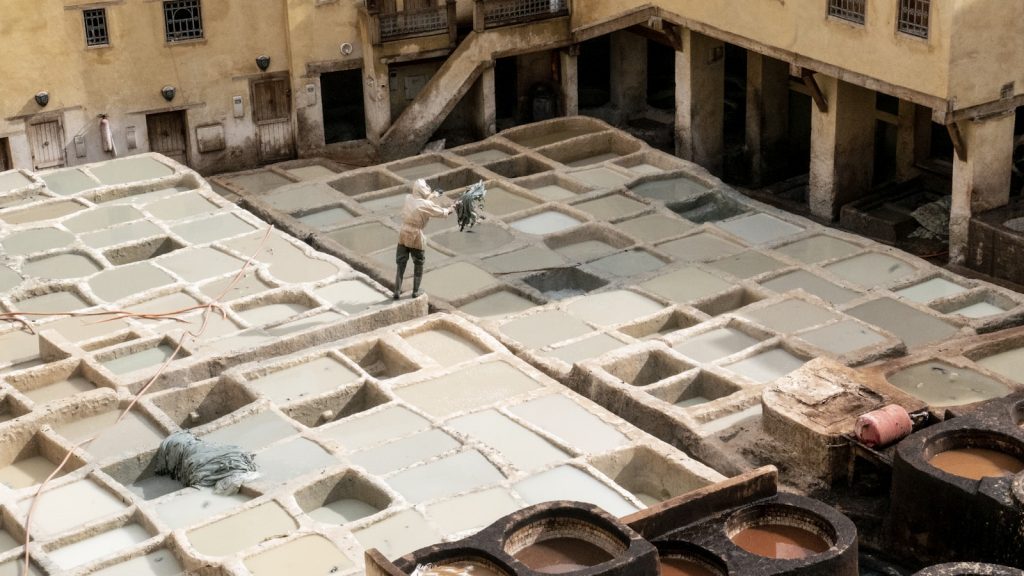
Before we talk names and locations, it helps to define the moving parts in the supply chain. In Indonesia, a typical exotic tannery on Java is set up to handle some or all of these stages:
- Raw / salted – fresh flayed skin, preserved in salt.
- Pickled – acid/salt preserved, ready for tanning.
- Wet-blue – chrome‑tanned, wet stage, pale blue colour.
- Crust – tanned, dried, usually dyed base colour but not fully finished.
- Finished – complete finishing (pigment, aniline, glazing, embossing, plating, etc.), ready for cutting.
On Java, not every exotic leather tannery runs the full line. Some specialise in wet-blue only, others in crust/finishing for export. Exotic Leather Wholesale is not a tannery; we act as a B2B sourcing desk sitting across several Indonesia crocodile tannery and lizard/python operations, so buyers can work with one trade interface instead of managing individual factories.
Main Exotic Species Tanned on Java
Indonesia is a CITES range state for several key reptile species. Java tanneries process both Indonesian-origin skins and imported CITES material (for example, some python and crocodile from neighbouring countries). Species are never interchangeable in trade — correct scientific naming is critical.
Below is a simplified view of what actually moves through Java reptile tannery lines:
- Crocodile – Crocodylus porosus
- Common trade name: saltwater crocodile / “poro”. Typically farmed (source code C) or captive-bred (F/D). Used for top-end handbags, SLG, watch straps. Indonesia is a key producer.
- Crocodile – Crocodylus siamensis
- Farmed Siamese crocodile, often used in slightly lower price brackets than C. porosus. Belly widths commonly 30–45 cm for bags and belts.
- Python reticulatus
- Reticulated python, widely tanned in Indonesia for shoes, bags and belts. Usually sold full-length, 1st grade focusing on the central dorsal pattern.
- Python bivittatus (where permitted)
- Less common than reticulatus in Indonesian trade but present in some tanneries, especially for overseas orders.
- Lizard – Varanus salvator
- Common water monitor lizard, used mainly for small leathergoods and footwear. Smaller panel sizes versus crocodile and python.
- Ray/“stingray” – family Dasyatidae
- Often marketed generically as stingray leather; tanned into very abrasion‑resistant panels, mainly for belts, wallets and shoes.
We do not handle “embossed as exotic” cowhide marketed as crocodile or python. If the fibre structure is bovine with embossing only, we describe it as embossed calf/cow, not crocodile or python.
CITES and Legal Sourcing From Indonesia
Most reptile skins handled by an Indonesia crocodile tannery or python/lizard tannery are listed on CITES Appendix I or II. That status governs international trade, not local Indonesian tanning itself.
Key trade points:
- Crocodylus porosus & Crocodylus siamensis – usually Appendix II for Indonesia farm production, with quotas and specific source codes (C, F, D).
- Python reticulatus & Varanus salvator – generally Appendix II, wild (W) and ranched/farmed (R/C/F) depending on origin and management programme.
On the documents you will typically see:
- Source codes: W (wild), R (ranched), C (farmed), F (captive-bred), D (Appendix I bred-for-commerce under approved programme).
- Purpose code: usually T (commercial).
Any import from Indonesia requires:
- Proper export permit from the Indonesian CITES Management Authority; and
- Whatever import permit and other documents your own jurisdiction requires.
Nothing here is legal advice. CITES rules vary by country and change over time. Always confirm requirements with your national CITES authority or customs broker before shipment. Our role at Exotic Leather Wholesale is to work only with suppliers who operate within the CITES system and to align documentation with your broker’s needs.
How Java Reptile Tanneries Grade Skins
Grading in exotic leather is highly standardised globally because it directly maps to what you can cut. Java follows the same commercial logic you see in France, Italy or Singapore.
- Crocodile – graded primarily on the
- Python – graded on the central pattern area (back cut) and the uniformity of colour/scale. Open cuts, knife marks, bug damage and clumsy flay reduce grade.
- Lizard – similar to crocodile but panel‑driven: clarity of small scales, absence of mechanical damage and pinholes, good shape.
Most Java tanneries will sell:
- Selection lots: e.g., 80–90% Grade I, rest Grade II, or mixed commercial Grade II–III for footwear.
- Full lots: as collected, with a blend of I–IV, priced accordingly.
For high-watch brands or top-tier leather goods, European and Singapore finishing houses may still be preferred for very tight Grade I selection and ultra-consistent finishing. Java can achieve similar technical levels on many articles, but not all tanneries are set up for ultra‑narrow tolerances and complicated effects.
Measurements and How Java Compares to France/Italy/Singapore
Trade is obsessed with measurement because it dictates pattern yield and pricing. Across the industry you will see:
- Crocodile: measured at the widest belly width in centimeters (cm), often grouped in size bands (e.g. 25–29, 30–34, 35–39 cm).
- Python: measured by length (cm) and usable width, but priced mostly per piece by length band.
- Lizard: measured by piece size categories or by area in square decimetres (dm²) in some export contracts.
Below is an indicative comparison of what you can expect by region; this is directional, not a ranking. Individual tanneries vary.
| Region | Typical Focus | Measurement & Sorting Discipline | Where Java Fits |
|---|---|---|---|
| Java (Indonesia) | Crocodile, python, lizard, ray for mid-to-high market | Standard commercial grading and width/length bands, solid belly-width measurement practices | Cost-competitive; good technical capability, especially for crust & simpler finishes; improving high-lux standards |
| France/Italy | High-luxury finished skins, complex effects, aniline/glazed, brand-specific specs | Extremely tight tolerance on width, grade and colour matching, rigorous area yield focus | Benchmark for finishing sophistication and selection lots intended for top-tier maisons |
| Singapore | High-end crocodile finishing, primarily C. porosus for global luxury houses | Very precise belly-width & defect mapping, strong selection for watch and SLG panels | Often used as reference for gloss, depth of colour and defect control on crocodile |
Java’s strength is the ability to turn large volumes of CITES-compliant skins into competitively priced crust and finished leather, with robust basic grading and measurement. For highly specialised colour matching to an established maison’s legacy shades, European or Singaporean finishers remain a common choice. Some Indonesian tanneries, however, now work under direct specification from global brands, and the capability overlap is growing.
Indicative Price Ranges, MOQs and Lead Times (2025–2026)
All pricing in the exotic trade is by quote and influenced by:
- Species and size band.
- Grade mix and selection tightness.
- Stage (raw vs wet-blue vs crust vs finished).
- Volume, colour complexity, finishing steps.
- CITES documentation and logistics.
The following indicative wholesale ranges for Java production are compiled from current trade levels and last verified June 2026. Your actual quote may be above or below these, depending on specification and market conditions.
| Species / Stage (Java) | Grade / Size focus | Indicative wholesale range (USD) ex‑works, by quote |
Typical MOQ | Indicative lead time |
|---|---|---|---|---|
| Crocodile (C. porosus / C. siamensis) – crust | Commercial Grade II–III, 30–39 cm belly | ~USD 200–450 per skin | 50–150 skins per colour/lot | 4–8 weeks if crust base in stock; 8–12 weeks for new lots |
| Crocodile – finished (pigmented / semi-aniline) | Grade I–II, 32–40 cm for bags/SLG | ~USD 350–800 per skin | 30–80 skins per colour for standard shades; more for custom | 6–12 weeks including colour lab & approvals |
| Python reticulatus – crust | Full-length, Grade I–II, 250–320 cm | ~USD 20–60 per skin | 200–500 skins per colour/finish band | 3–6 weeks for stock colours; 6–10 weeks for new production |
| Python reticulatus – finished (shoes/bags) | Selected Grade I, fashion colours | ~USD 35–90 per skin | 100–300 skins per colour | 4–10 weeks depending on effect (metallic, washed, etc.) |
| Lizard (Varanus salvator) – finished | Small/medium panels, SLG grades | ~USD 25–70 per skin | 100–300 skins per colour | 4–8 weeks |
| Ray (“stingray”) – finished | Belt/wallet panels, various grains | ~USD 15–45 per panel | 100–200 panels per colour | 4–8 weeks |
These numbers illustrate why many brands use an exotic leather tannery Indonesia as part of their sourcing mix: Java can deliver price-effective crust and finished skins, particularly for mid‑to‑high segments below the very top luxury tier. For ultra‑select Grade I crocodile belly for flagship handbags and small watch panels, some buyers still consolidate in Singapore or Europe.
If you want specific pricing for your project or to test Java against your existing suppliers, you can plan your trip through us by WhatsApp or email with a detailed RFQ and we will map it to suitable tanneries.
Who Actually Buys From Java Exotic Tanneries (And Why)
Across the trade, the typical buyers for Java reptile output are:
- Footwear manufacturers – especially in Italy, Spain, Portugal, China and Vietnam, using python, lizard and ray for luxury and premium shoes.
- Bag and small leather goods ateliers – from independent brands up to global luxury houses, sourcing crocodile and python for seasonal and core lines.
- Watch strap specialists – needing specific belly panel sizes and defect maps, often combining Java tanning with final finishing or splitting in Europe.
- OEM/ODM factories – producing for multiple labels and needing cost‑competitive, compliant exotic skins with reliable supply.
- Regional brands in Asia – particularly in Japan, Korea and Southeast Asia, drawing on geographic proximity and freight advantages.
The main reasons these buyers incorporate Indonesia crocodile tannery and python/lizard capacity into their sourcing plans:
- Cost-to-quality ratio – Java is usually cheaper than top‑tier European finishing, while still delivering technically sound tanning for many applications.
- Access to raw material – Indonesia is a major source country for reticulated python, lizard and crocodile, which reduces upstream friction.
- Volume capability – for medium and large runs, several Java operations can scale without excessively long lead times.
- CITES familiarity – export processes are routine at the main tanneries; documentation pipelines exist with Indonesian authorities.
What Java Tanneries Are Good At – And Where Europe/Singapore Still Lead
To set realistic expectations, it helps to separate tanning fundamentals from finishing finesse.
Java strengths:
- Chrome tanning and crust production for python, crocodile, lizard and ray at competitive cost.
- Standard finishing – solid pigments, basic semi‑aniline, simple metallics, antique/wash finishes suitable for many footwear and bag lines.
- Large colour lines – seasonal ranges where ultra‑tight colour matching between seasons is not critical.
Where France/Italy/Singapore often retain an edge:
- Heritage colour matching – reproducing exact maison shades season after season for global rollouts.
- Ultra-high-gloss crocodile – very high reflectivity, deep colour, and strict rejection of minor belly imperfections.
- Complex multi-stage effects – layered aniline, hand-padding, sophisticated metallics and special physical feels.
- Extreme selection – watch strap and SLG specs where one tiny defect renders a panel unusable for front-facing parts.
For many brands, the pragmatic strategy is blended:
- Use Java for core colours, larger runs, and parts of the range where yield and cost matter more than ultra‑signature finishing.
- Use France/Italy/Singapore for halo collections and styles where finishing and panel perfection are central to brand positioning.
Our role at Exotic Leather Wholesale is to map your line plan and technical requirements into this reality and suggest where Java is the right answer – and where it may not be.
Working With Exotic Leather Wholesale as Your Indonesia Sourcing Desk
We position ourselves as a neutral B2B sourcing desk, not a single tannery’s sales office. Practically, that means:
- We interface with multiple tanneries on Java, matching each project to the right capability (species, finishing, capacity).
- We speak both sides’ language: your bill of materials, lab dip and QC expectations, and the factory’s production constraints.
- We are focused on CITES-compliant trade only and help align documentation with your forwarder and customs broker.
- No one can pay to change what we publish; if you proceed with our partner they may pay us a referral fee at no extra cost to you.
A typical workflow for a new client looks like this:
- Initial brief – you share your species, grades, colours, finish references, yield expectations and target price bands.
- Feasibility & indicative ranges – we respond with realistic species/grade suggestions, indicative 2025–2026 ranges and MOQs based on current Java capability.
- Sampling – lab dips or test skins from selected tanneries; adjustments based on your QC feedback.
- Formal quoting – confirmed price, MOQ, lead time, payment terms, and CITES/logistics plan.
- Production oversight – check-in at key stages, photo/video updates where practical, and coordination with your shipper.
If you want to explore using a Java exotic tannery for part of your next season, you can plan your trip with us via WhatsApp or email – share your tech packs or current supplier specs, and we’ll build an apples‑to‑apples comparison.
FAQs About Exotic Leather Tanneries in Indonesia
What species of exotic leather can I source from Java tanneries?
You can source CITES-listed crocodile (mainly Crocodylus porosus and Crocodylus siamensis), reticulated python (Python reticulatus), lizard (Varanus salvator) and ray (family Dasyatidae). Some tanneries also process imported exotic skins from other origins, always under CITES permits. We do not handle embossed cowhide marketed as exotic; those products are correctly sold as embossed bovine.
Are Indonesian exotic leather tanneries CITES-compliant?
The established Java reptile tanneries that export are set up to operate within the CITES framework, meaning they obtain export permits for CITES-listed species. Compliance, however, involves both the exporter and the importer. You must confirm your own country’s import permit requirements and work with a customs broker. Our role is to source from compliant suppliers and coordinate documentation, not to provide legal advice.
How do Java exotic leather prices compare to European or Singapore tanneries?
For 2025–2026, Java is generally more cost-effective, especially for python, lizard and mid‑grade crocodile crust or finished skins. Indicative ranges for Java crocodile crust often sit around USD 200–450 per skin for commercial grades, while finished crocodile for bags can range around USD 350–800 per skin, ex‑works, depending on size and grade. Top-tier European and Singapore finishers typically command higher prices, especially for ultra-select Grade I and complex finishes.
What MOQs and lead times should I expect from an Indonesia crocodile tannery?
For crocodile on Java, realistic MOQs are often 30–80 skins per colour for finished leather and 50–150 skins per lot for crust, depending on grade and belly size. Lead times are commonly 6–12 weeks for finished crocodile, including colour development, and 4–8 weeks for crust if raw material is available. Python and lizard usually require higher MOQs but shorter lead times for standard colours.
Can you help me develop custom colours or finishes with Java tanneries?
Yes. We regularly coordinate lab dips and finish development with Java tanneries. Solid pigments, semi‑aniline, basic metallics and common fashion effects are well within capability. For very complex or heritage finishes tied to long-running brand palettes, we may recommend splitting production between Java and a European or Singapore finisher, depending on your risk tolerance and brand requirements.